• Join Today’s Live Event
  • Class 3: Register Now
  • Class 4: Register Now
  • Institute Login
Grayscale
  • Investment Products
    • ETFs/ETPs
    • Publicly Traded Funds
    • Private Funds
    • All Products

    Join the Grayscale Community

    Subscribe for the latest insights and company updates from Grayscale.

  • Research
    • Market Commentary
    • Reports
    • Videos & Webinars
    • Explore All

    Join The Grayscale Community

    Subscribe for the latest insights and company updates from Grayscale.

  • Resources
    • Product Documents & Data
    • Regulatory Filings
    • Tax Center
    • FAQs
    • Directed Share Program FAQs
    • Explore All

    The Grayscale Glossary

    Find simple definitions for common crypto asset investing terms, compiled by the Grayscale team.

    • Explore All

    Join the Grayscale Community

    Subscribe for the latest insights and company updates from Grayscale.

    • Explore Resources

    Join the Grayscale Community

    Subscribe for the latest insights and company updates from Grayscale.

    • Currencies
    • Smart Contract Platforms
    • Financials
    • Consumer & Culture
    • Artificial Intelligence
    • Utilities & Services
    Explore All
  • Company
    • Company Overview
    • Press
    • Careers

    Join the Grayscale Community

    Subscribe for the latest insights and company updates from Grayscale.

  • The Stack Blog
    • Fed’s Mid-Cycle Adjustment Unlikely to Bother Crypto Markets
    • Can Bitcoin Improve Private Market Portfolios?
    • Zcash Mining Is Taking Off

    Subscribe to The Stack

    Receive crypto intelligence and timely insights on digital asset investing directly in your inbox.

  • Grayscale Institute
    • Understanding Digital Asset Investing
      On Demand
    • Understanding Crypto Sectors: Currencies and Smart Contract Platforms
      On Demand
    • Understanding Crypto Sectors: Financials and Utilities & Services
      On Demand
    • Understanding Crypto Sectors: Artificial Intelligence and Consumer & Culture
      Register Now
    • In Practice: How to Integrate Digital Assets into Traditional Portfolios
      Coming Soon

    The Fundamentals

    A companion series to the Digital Asset Investing Fundamentals Course.

    • Learn from Crypto Natives
Start Investing
Login
Institute Home July 2026

Understanding Crypto Sectors: Smart Contract Platforms

Key Takeaways

  • Smart contract platforms are blockchains that function as “operating systems” for smart contracts—the second-largest crypto sector.
  • Their tokens can earn substantial fees, so they’re valued mostly as financial claims and can pay staking yield.
  • A common misperception is that crypto assets have no fundamental value. In fact, Grayscale Research finds that fee revenue correlates more closely with the market cap of smart contract platforms than other fundamentals—value accrues through network usage.
DOWNLOAD PRIMER

I. What are smart contract platforms?

Smart contract platforms are programmable blockchains. They function as “operating systems” on which open-source programs—known as “smart contracts”—can be built and whose output can be stored. Ethereum launched in 2015 as the first notable smart contract platform, laying the foundation for an ecosystem of decentralized applications.

These decentralized applications—traditionally built by third-party developers—run smart contract programs that can perform many tasks and enable a variety of onchain decentralized finance (DeFi) business models, such as borrowing, lending, and trading (all outside of the traditional banking or brokerage industries). Decentralized apps can also perform tasks and offer services beyond finance, such as peer-to-peer data storage and blockchain interoperability.

Every transaction or operation on these networks is paid for with the platform’s native token (think of the native token as the gasoline powering the platform’s engine), so the network captures value from all user activity, including transaction activity, user fees, and total value locked (TVL). Additionally, decentralized applications built on top of smart contract platforms can have their own non-platform-native tokens. These tokens are investable as well, and we will cover many of them in subsequent primers in this series.

In the remainder of this primer, we will first dimension this important digital asset sector. Using a consistent template, we will then profile several representative investable tokens— highlighting their market size, investment thesis, and risk considerations—so you can learn and compare them side by side.

II. Sizing the sector

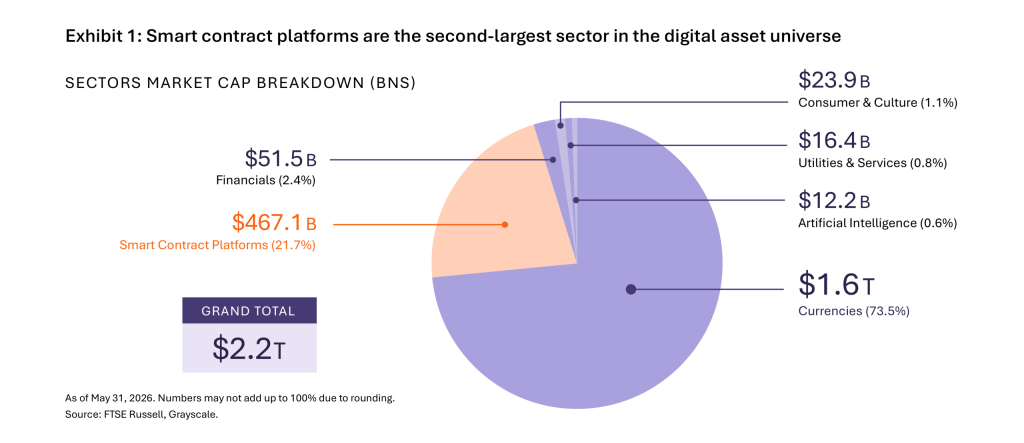
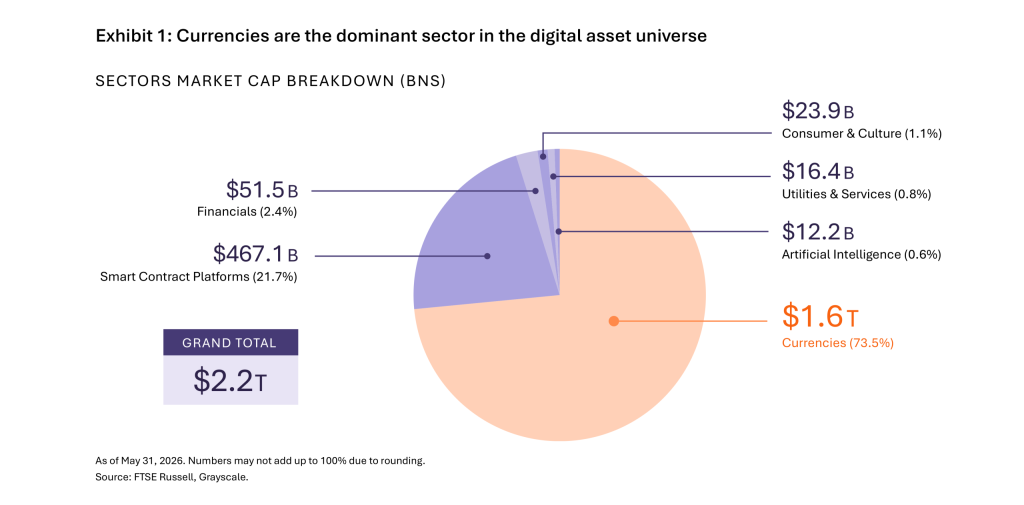
The first step in understanding crypto sectors is to dimension them. Exhibit 1 shows that smart contract platforms are the second-largest crypto sector—about 21.7% of total digital- asset market cap. Our index encompasses 41 smart contract platforms (compared, for example, to 13 tokens in the Digital Currencies sector). The sector is large because it encompasses the networks that function as the “operating system”—known as Layer 1 networks—powering a vast range of digital assets.1
The Smart Contract Platform sector is home to many popular assets in the digital asset world. In this primer, we highlight a group of representative investable tokens: Ethereum (ETH), Avalanche (AVAX), Solana (SOL), BNB Chain (BNB), and Sui (SUI).

Also, before we continue, a word on key terms and structure. As a companion to the Grayscale Institute’s Digital Asset Investing Fundamentals course, the knowledge in this primer series, like in the course, builds chronologically—this primer inherits knowledge from the previous one, and so on. In this light, please refer back to either previous classes (available on demand) or previous primers if you feel like you need a refresher at any time on certain topics, such as proof-of-work and proof-of-stake blockchains, the role of miners and validators, our asset valuation approach by behavior (commodity or financial claims), among others. All materials are available on the Grayscale Institute website.

III. Ethereum: The first smart contract blockchain

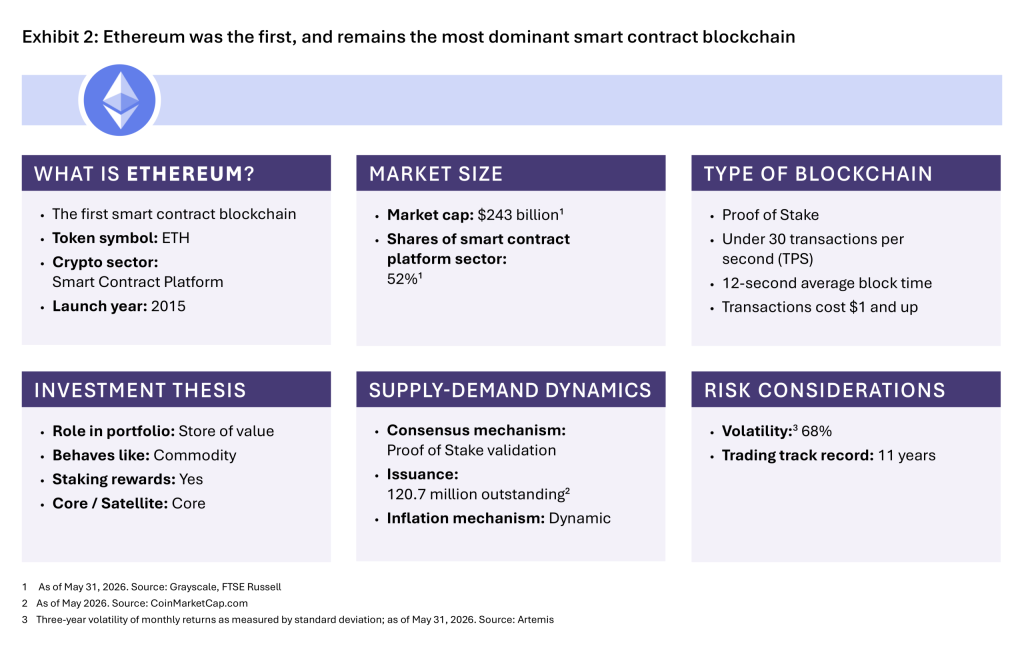
Ethereum launched in 2015, giving it an 11-year track record, and its native token, Ether, trades under ETH. As of May 2026, its market cap was roughly $243 billion, about 52% of Grayscale’s smart contract platform sector. Ether operates like a cryptocurrency and is used to pay for computation, incentivize validators, and serve as collateral.

Unlike digital currencies, Ethereum runs on a Proof-of-Stake blockchain: Validators are chosen to write blocks based on the size of their stake (e.g., a validator with 1% of staked Ether writes approximately 1% of blocks), earning rewards paid in kind (i.e., in Ether).

How value accrues: The key is usage. As more applications are created and grow more popular, network usage and the fees paid to validators rise—a virtuous circle. Validators earn staking rewards, priority fees, and maximum extractable value (MEV). Users pay “gas” fees based on a program’s complexity and network congestion; during congestion, a portion of the ETH paid is burned and retired from supply. Because issued tokens (funding staking yield) are offset by burned tokens, ETH supply is variable (i.e., net ETH issuance is “issuance minus burn”: When network activity is high, burning can exceed new issuance and the supply of Ether can shrink; when activity is low, the supply can grow). Priority fees resemble dividends; burned base fees resemble buybacks.

The Ethereum blockchain provides the network and is supplemented by the Ethereum Virtual Machine (EVM), the environment where smart contracts are executed. (Think of the EVM as the engine that runs the smart contracts and the blockchain as the place where the output of those transactions is secured and written.) Ethereum’s Layer 1 is relatively slow, handling about 7 to 15 transactions per second. As a result, much activity is delegated to Layer 2 networks—the function of which is to speed up transaction settlement and to lower costs. L2 networks—such as Base, Optimism, and Arbitrum—execute EVM-compatible transactions cheaply (often under 2 cents versus $1+ on L1) and settle results back to the secure, decentralized Layer 1.

From an allocation perspective, given its size, track record, and widespread ownership, we consider ETH a core asset in a digital asset portfolio.
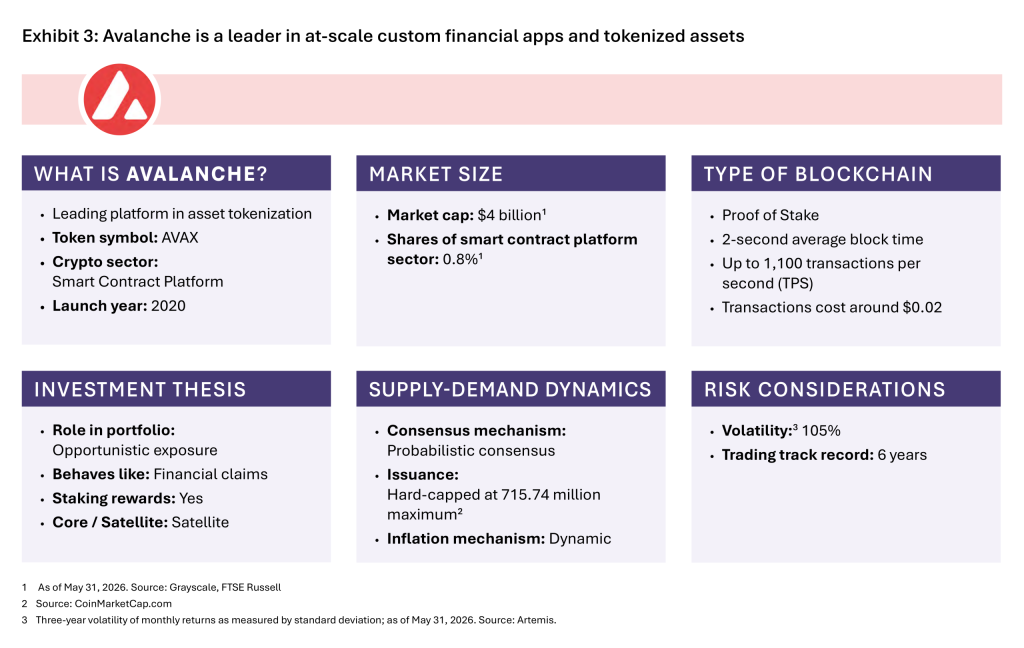
IV. Avalanche: Scale and customization

Avalanche launched in 2020, giving it a 6-year track record, and its token trades as AVAX. As of May 2026, its market cap was $4 billion, about 0.8% of the sector. Like Ethereum, it runs on Proof of Stake, with a two-second average block time and up to 1,100 transactions per second.

Avalanche is best perceived as a network of Layer 1 blockchains. It is built to address the “blockchain trilemma”—scalability, decentralization, and security— through a three-chain architecture: the X-Chain (creating and transferring assets), the C-Chain (Ethereum-compatible smart contracts), and the P-Chain (validator coordination and creating custom Avalanche L1s). Its differentiator is mass customization: Avalanche L1s are application-specific blockchains tailored to different regulatory, geographic, or technical requirements, letting enterprises build their own chains without affecting the broader network.

This flexibility has driven real-world adoption—gaming titles, asset managers such as KKR and Apollo tokenizing funds, public-sector projects digitizing property and vehicle-title records, and sports and entertainment partnerships. AVAX is used for fees, staking, securing the network, and governance.

From an allocation perspective, we consider AVAX a satellite holding in a digital asset portfolio, in part due to its still relatively small market capitalization.
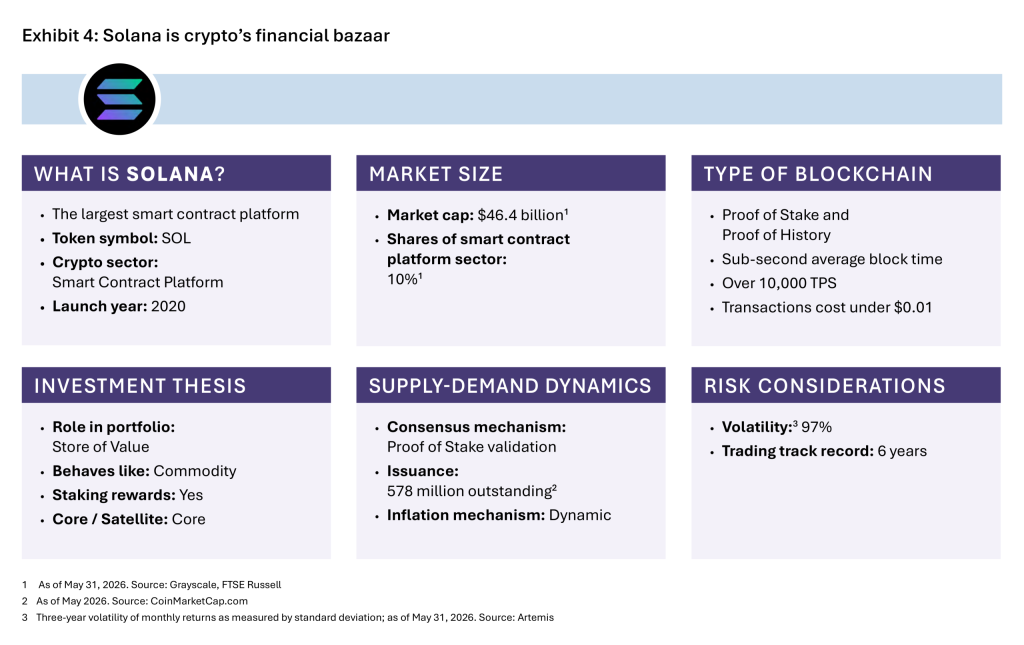
V. Solana: Crypto’s financial bazaar

Solana is the largest smart contract platform by transaction volume. It launched in 2020, giving it a 6-year track record, and its native token trades as SOL. As of May 2026, its market cap was roughly $46.4 billion, about 10% of the sector. It runs on a Proof-of-Stake blockchain optimized for performance—extraordinarily cheap and fast.

Today Solana is the category leader in users, transaction volume, and transaction fees. It hosts industry-leading applications across DeFi, consumer and social apps, and physical infrastructure (DePIN), and offers one of the best new-user experiences in crypto. The network produces new blocks every 400 milliseconds with finality in about 12 to 13 seconds,2 and year-to-date median daily fees have averaged about one-tenth of one cent, helped by local fee markets that limit fee competition to specific in-demand apps.

Solana also pursues a distinct technical strategy: It uses the proprietary Solana Virtual Machine (SVM), which is not compatible with the Ethereum Virtual Machine. SVM applications can’t easily be ported to non-SVM chains, potentially contributing to sticky demand. More than 1,000 full-time developers work on Solana, and that community is growing faster than on other platforms.

From an allocation perspective, we consider SOL a core holding in a digital asset portfolio given its size, leadership, and developer community.
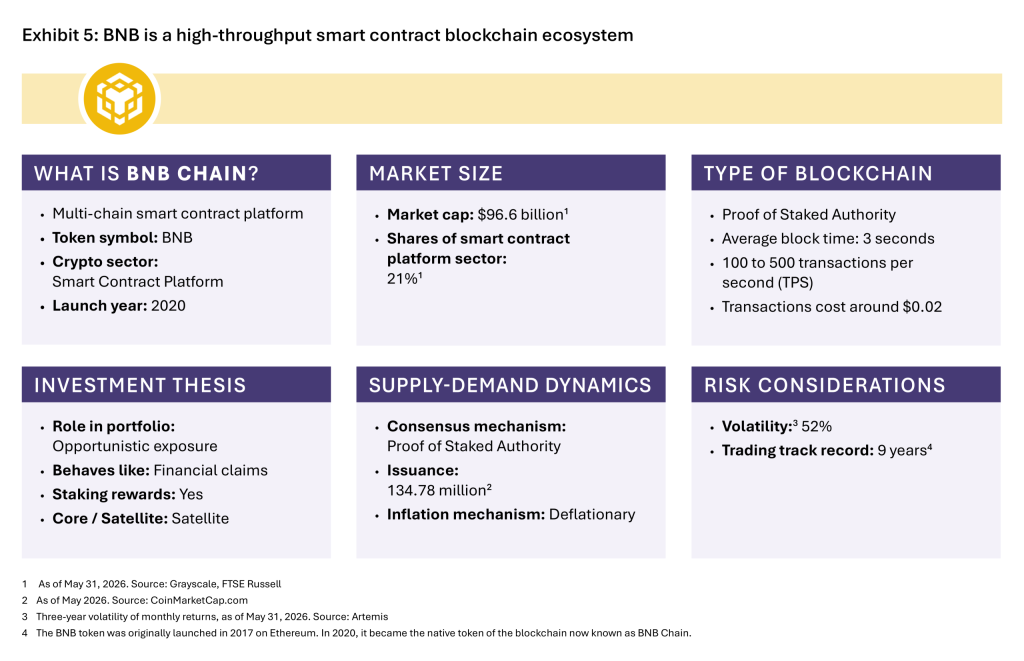
VI. BNB Chain: A high-throughput ecosystem

BNB Chain is a high-throughput smart contract ecosystem built for mass-market applications. It was originally launched by Binance as Binance Smart Chain in 2020 and rebranded in 2022. Its native token—which was originally launched in 2017 on Ethereum and became the token of the blockchain now known as BNB Chain in 2020—has a nine-year track record and trades as BNB. As of May 2026, its market cap was roughly $96.6 billion, or 21% of the sector—the second- largest platform by market cap (after Ethereum) and third by TVL. It runs on a Proof of Staked Authority network with three- second blocks and up to 500 transactions per second, typically costing around two cents.

BNB has a deflationary tokenomics model: The maximum supply has already been reached, and the circulating number regularly declines through token burning, with an initial supply of 200 million targeted to fall to a floor of 100 million. The ecosystem has three interoperable parts—the BNB Smart Chain (an EVM-compatible Layer 1), opBNB (a Layer 2 rollup on the Optimism OP Stack), and BNB Greenfield (decentralized storage). Its Proof of Staked Authority uses 21 validators elected from a larger pool, enabling millions of transactions per day.

Combined with Binance’s distribution, this has made BNB Chain a leading network for retail DeFi, stablecoin payments, gaming, and tokenization.

From an allocation perspective, we consider BNB a satellite holding in a digital asset portfolio.
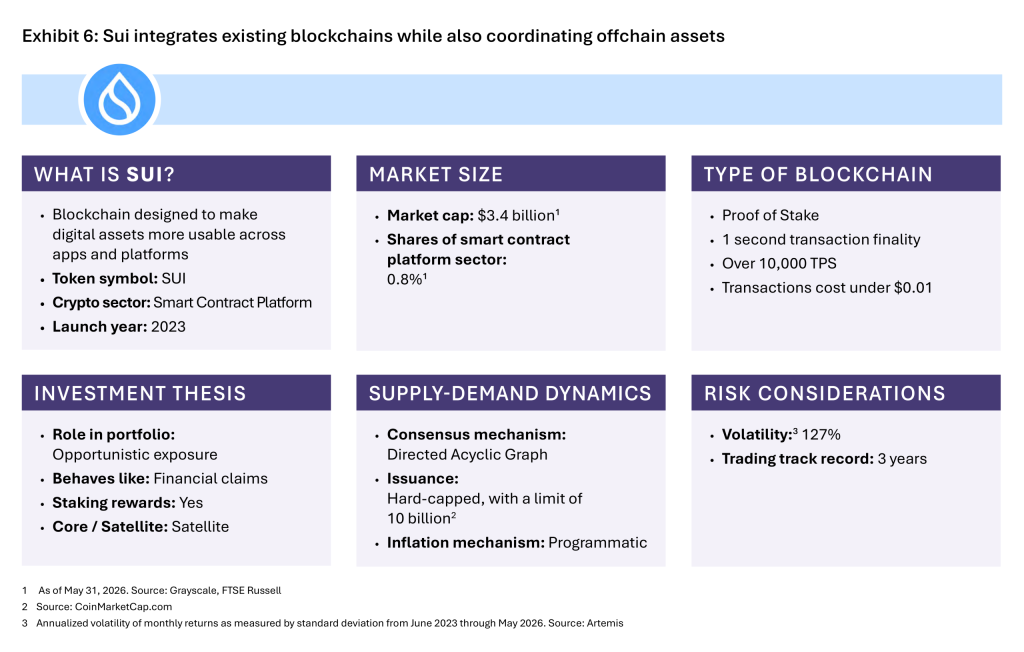
VII. Sui: The usability platform

Founded by key members of Facebook’s Diem project, Sui is known for ease of integration with existing blockchains and coordinating off-chain assets. It launched in 2023, giving it a 3-year track record, and its native token trades as SUI. As of May 2026, its market cap was roughly $3.4 billion, about 0.8% of the sector. Like Ethereum and Avalanche, it runs on Proof of Stake; like Solana it is extraordinarily fast and cheap, with one-second finality and over 10,000 transactions per second. Supply is capped at 10 billion (roughly four billion outstanding, with more than half expected after 2030).

Sui prioritizes usability and scalability, aiming to exceed even the best Web 2.0 experiences—offering sub-second speeds, private on-chain data storage, password recovery, and peer- to-peer transactions without an internet connection. It is positioned as a global coordination layer, letting users control assets across blockchains and offchain infrastructure from Sui, and its capacity grows with computational power as validators add servers. As a result, Sui offers the highest theoretical throughput, lowest cost, and fastest finality among the five largest platforms.

From an allocation perspective, we consider SUI a satellite, opportunistic holding in a digital asset portfolio.
VIII. How to access the tokens in the Smart Contract Platforms sector

There are two primary ways to access digital assets across all sectors: direct ownership and ownership through commingled vehicles.3

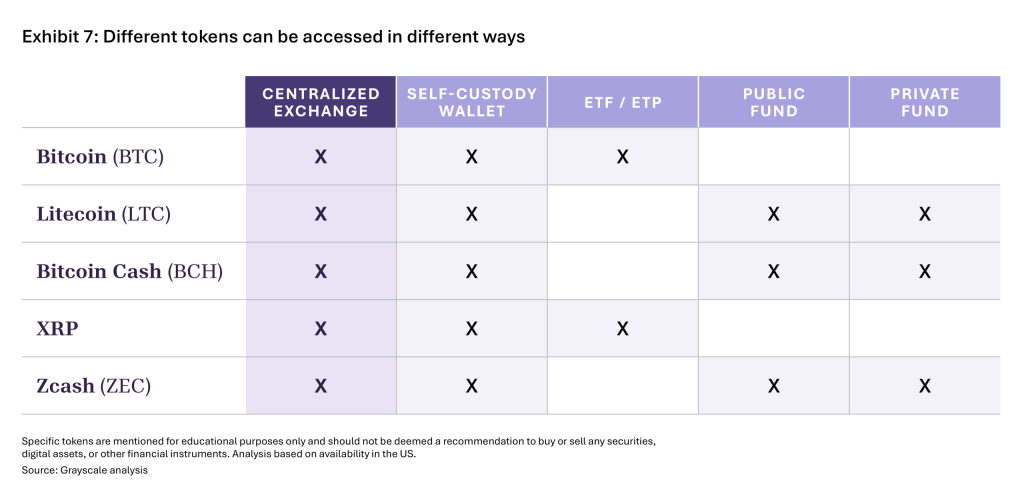
Direct ownership means opening an account at a centralized exchange, completing know-your-customer verification, depositing fiat currency, and purchasing the asset. From there, an investor can leave holdings on the exchange or move to self-custody in a personal digital wallet. Commingled vehicles such as exchange-traded products (ETPs), exchange-traded funds (ETFs), and private funds offer exposure through structures investors already know and can be held in existing brokerage or retirement accounts.

Choosing between the two options comes down to a trade- off between control and convenience. We believe that for most investors seeking a diversified portfolio of digital assets, commingled vehicles, particularly ETPs and ETFs, offer the simplest and most operationally efficient way to gain exposure to digital assets, which helps explain the accelerating pace of institutional adoption we have seen recently.

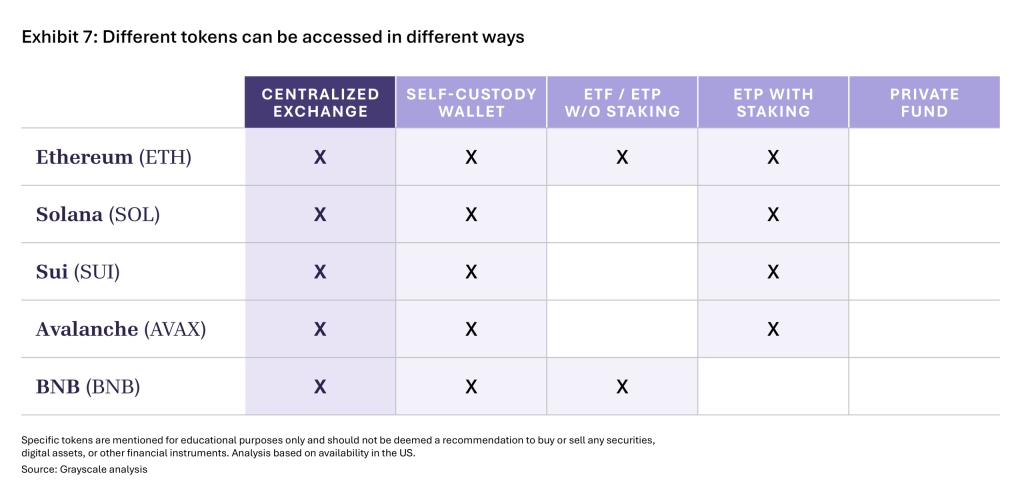
Exhibit 7 details investable vehicle availability for each of the tokens covered in this primer.
1 – As of May 31, 2026. Source: FTSE Russell, Grayscale. https://www.grayscale.com/crypto-sectors
2 – https://chainspect.app/chain/solana

3 – For a detailed explanation, please refer to either the first class of the Digital Asset Investing Fundamentals Course or the first primer of this series. Both are available at https://grayscaleinstitute.com/


Important Information

Investments in digital assets are speculative investments that involve significant risk, including a partial or total loss of invested funds. Investments in digital assets are not suitable for any investor that cannot afford loss of the entire investment.

This material is not intended to be relied upon as a forecast, research, or investment advice, and is not a recommendation, offer or solicitation to buy or sell any securities or to adopt any investment strategy. The opinions expressed may change as subsequent conditions vary. The information and opinions contained in this material are derived from proprietary and nonproprietary sources deemed by Grayscale to be reliable, are not necessarily all-inclusive and are not guaranteed as to accuracy. Past performance is no guarantee of future results. There is no guarantee that any forecasts made will come to pass. Reliance upon information in this material is at the sole discretion of the reader.

You are solely responsible for evaluating and acting upon the education and information contained in this material. Grayscale will not be liable for direct or incidental loss resulting from applying any of the information obtained from these materials or from any other source mentioned. Grayscale does not render any legal, tax or accounting advice and the education and information contained in this material should not be construed as such. Please consult with a qualified professional for these types of advice. Grayscale and its employees may hold certain of the digital assets mentioned herein.

All content is original and has been researched and produced by Grayscale Investments Sponsors, LLC (“Grayscale”) unless otherwise stated herein. No part of this content may be reproduced in any form, or referred to in any other publication, without the express consent of Grayscale.

© 2026 Grayscale. All trademarks, service marks, and/or trade names (e.g., G™, GRAYSCALE®, GRAYSCALE CRYPTO SECTORS™, and GRAYSCALE INVESTMENTS®) are owned and/or registered by Grayscale.Content goes here!

Associated Class

Now On Demand
Understanding Crypto Sectors: Currencies and Smart Contract Platforms
Now On Demand • 1.5 CE Credits

Related Classes

Now On Demand
Understanding Digital Asset Investing
Now On Demand • 1 CE Credit
Now On Demand
Understanding Crypto Sectors: Financials and Utilities & Services
Now On Demand • 1 CE Credit
Live Class
Understanding Crypto Sectors: Artificial Intelligence and Consumer & Culture
Oct 1, 2026 • 11:00AM ET • 1 CE Credit

Archives

  • October 2026
  • September 2026
  • July 2026
  • June 2026
  • May 2026
  • April 2026

Categories

  • Locked
  • No Date
  • Primers
  • The Stack

Understanding Crypto Sectors: Digital Currencies

Key Takeaways

  • Digital currencies are the largest crypto sector.
  • Their supply and inflation are typically hard-coded.
  • Bitcoin is the oldest and largest of all digital currencies.
  • Digital currencies are typically valued as commodities using supply-and-demand analysis.
  • We consider Bitcoin a core holding in a digital asset portfolio; the remaining digital currencies covered in this primer—Bitcoin Cash, Litecoin, Zcash, and XRP—could be considered satellite holdings.
DOWNLOAD PRIMER

I. What are digital currencies?

Simply put, a digital currency is very much like a traditional currency, except that it lives completely online. Traditional currencies have typically served one of three purposes: they are a store of value, a unit of account, or a medium of exchange. Digital currencies are the same.

The value of any currency has always been a reflection of its perceived worth among users as well as aggregate demand considering local, societal, and global macroeconomic risks. The same tenets hold true with digital currencies.

There is, however, a key difference: Decentralized digital currencies—of which Bitcoin is by far the most prominent— are not issued or controlled by a central government. Their supply and inflation are predetermined in code. In effect, they have a “monetary policy” that is hard-coded in the fabric of the blockchain/protocol. The economic incentives built into the blockchain remove the need for an intermediary— traditionally a central bank. In this way, cryptocurrencies are “trustless” (i.e., instead of trusting a centralized authority or intermediary, network users rely on the underlying code).

In the remainder of this primer, we will first dimension this important digital asset sector. Using a consistent template, we will then profile several representative investable tokens—highlighting their market size, investment thesis, and risk considerations—so you can learn and compare them side by side.

II. Sizing the sector

The first step in understanding crypto sectors is to dimension them. Exhibit 1 demonstrates how currencies are by far the largest sector in digital assets by market cap—about 73.5% of the value of all digital assets as measured by the Grayscale Crypto Sector Index—yet the smallest by number of constituents, at just 13 tokens.1

The Currencies sector has the lion’s share of the index primarily due to Bitcoin, which, as we will see in more detail soon, is the largest and oldest digital currency. But it’s not the only one, of course. In the remainder of this primer, we highlight, in addition to Bitcoin, four more representative investable tokens in the sector: Bitcoin Cash, Litecoin, Zcash, and XRP.

Also, before we continue, a word on key terms and structure. As a companion to the Grayscale Institute’s Digital Asset Investing Fundamentals course, the knowledge in this primer series, like in the course, builds chronologically—this second primer inherits knowledge from the first one, and so on. In this light, please refer back to either previous classes (available on demand) or previous primers if you feel like you need a refresher at any time on certain topics, such as proof- of-work and proof-of-stake blockchains, the role of miners and validators, or our asset valuation approach by behavior (commodity or financial claims). All materials are available on the Grayscale Institute website.

III. Bitcoin: The core asset

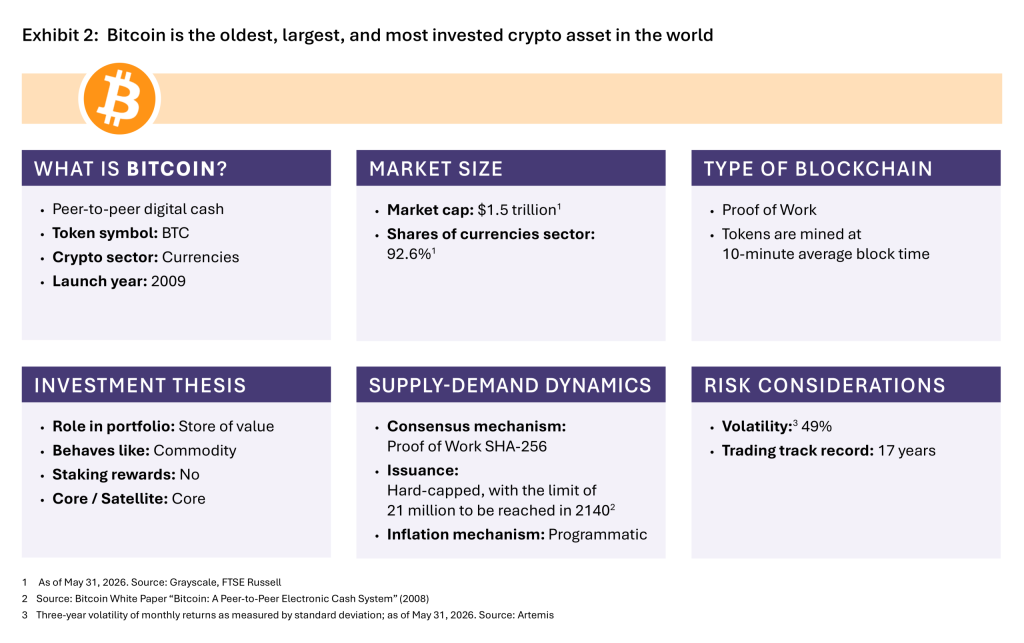
Bitcoin is peer-to-peer digital cash that serves as a store of value. Launched in 2009, it has a 17-year track record, and trades as BTC. It is the oldest of all digital currencies. As of May 2026, its market cap was roughly $1.5 trillion, about 92.6% of Grayscale’s currencies sector index. It runs on a proof-of-work blockchain with a 10-minute average block time (Exhibit 2).

The investment thesis for Bitcoin begins with the role it plays in a portfolio: We believe it works primarily as a store of value, akin to the role gold has played for ages. Like most digital currencies, it tends to behave like a commodity—its price is set primarily as a function of supply and demand.

Supply of Bitcoin is intentionally scarce—issuance is capped at 21 million tokens, more than 95% of which have already been mined—so its inflation mechanism is programmatic. New tokens are introduced as miners receive rewards for maintaining and securing the network as well as validating transactions. Every four years the block reward of Bitcoin given to miners is cut in half (from 3.125 in 2024 to 1.5625 in 2028), slowing supply growth and increasing scarcity, which may support prices in times of stable to rising demand.

On the demand side, two key sources stand out: Exchange- traded products and digital asset treasury companies (DATs)—publicly listed companies that hold crypto on their balance sheets. Together these entities held almost 13% of all Bitcoin at the end of May 2026. Some companies, such as Strategy, hold virtually their entire market capitalization in BTC. And some operating companies, such as Tesla or SpaceX, hold more than $1 billion in Bitcoin as an alternative to Dollars.

From an allocation perspective, given its size, track record, and widespread ownership, we consider Bitcoin a core asset—rather, the core asset, in a digital asset portfolio.

IV. Bitcoin Cash: A fork in the road

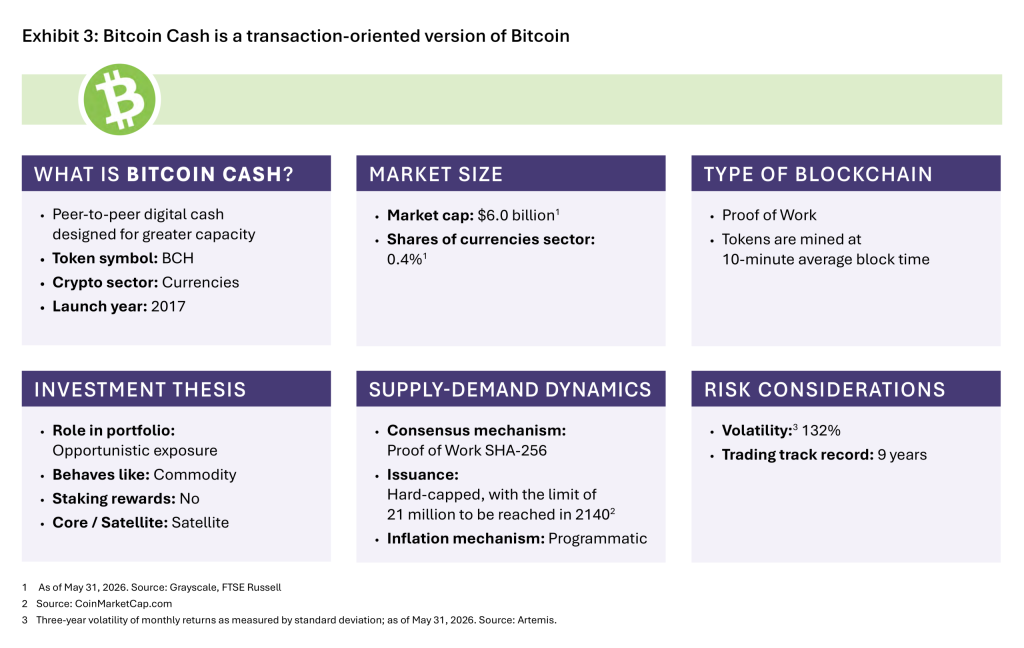
Bitcoin Cash has many commonalities with Bitcoin—in fact, they started from the same source code. It launched in 2017, giving it a 9-year track record, and it trades as BCH. As of May 2026, its market cap was $6 billion, about 0.4% of the currencies sector index. It runs on Proof of Work at a 10-minute block time, shares Bitcoin’s halving schedule and 21-million maximum supply, and uses the same SHA-256 hash algorithm (Exhibit 3).

The fork story: Bitcoin Cash is a hard fork of Bitcoin. A hard fork occurs when consensus on an algorithm change cannot be reached. In that event, a new blockchain is built with the updated rules while the original continues unchanged.

Advocates wanted to raise Bitcoin’s block size from 1 to 32 megabytes but could not get the votes. After agreeing to disagree, Bitcoin continued with a small block while Bitcoin Cash launched with an 8-megabyte block (later increased to 32-megabytes), theoretically processing far more transactions. Bitcoin owners received a distribution of Bitcoin Cash tokens when the fork was implemented in 2017.

From an allocation perspective, we consider Bitcoin Cash a satellite holding in digital asset portfolios.

V. Litecoin: Speed and efficiency

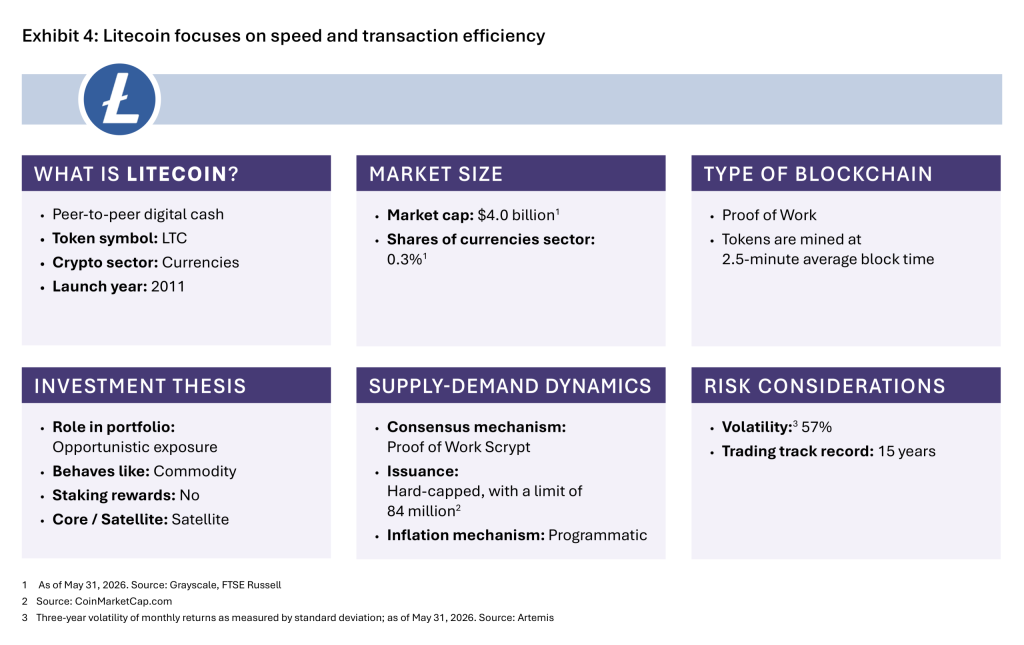
Litecoin also shares much of Bitcoin’s source code. It launched in 2011, giving it a 15-year track record, and trades as LTC. As of May 2026, its market cap was $4 billion, about 0.3% of the currencies sector index (Exhibit 4).

In essence, Litecoin is designed to be “four times Bitcoin”: four times the number of tokens (a maximum of 84 million) and four blocks written in the time Bitcoin writes one—new blocks every 2.5 minutes versus 10. Rather than SHA-256, it uses a Proof of Work process built on the Scrypt algorithm, designed to be faster and accessible to a broader range of hardware.

Unlike Bitcoin Cash, Litecoin is technically not a fork— the team independently built a blockchain with four times Bitcoin’s capacity rather than seeking consensus to change Bitcoin, so Bitcoin holders did not receive a Litecoin distribution. Together, Bitcoin Cash and Litecoin increase capacity and speed respectively, leaving Bitcoin as the store-of-value token.

From an allocation perspective, we consider Litecoin a satellite holding in a digital asset portfolio.

VI. Zcash: Digital cash with privacy

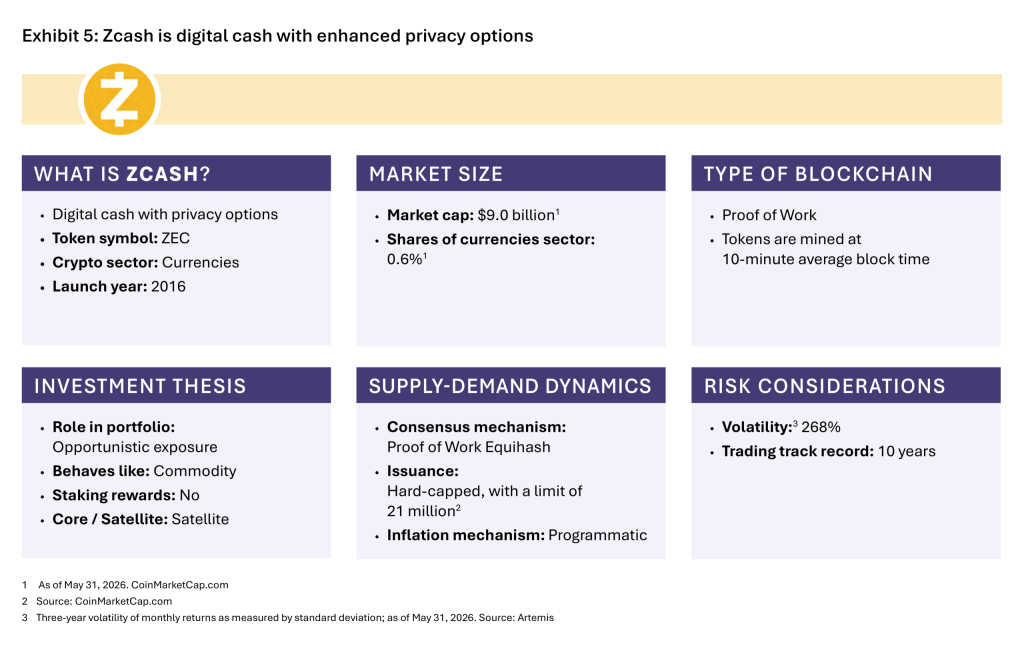
Zcash launched in 2016, giving it a 10-year track record, and it trades as ZEC. As of May 2026, its market cap was $9 billion, about 0.6% of the currencies sector index. Like Bitcoin, it is a Proof of Work currency with a 21-million maximum supply, but rather than SHA-256 it uses the Equihash algorithm. Herein lies the key distinction: Zcash adds zero-knowledge cryptography for privacy-preserving transactions. Zcash is the best-known privacy-preserving blockchain today (Exhibit 5).

Transparent vs. privacy-preserving blockchains: By default, Bitcoin transactions are public—each wallet has an address whose transactions can be viewed on a block explorer, and over the course of time activity often becomes linkable through exchanges, counterparties, and analytics. Zcash lets users choose transparent or shielded transactions; in a shielded transfer the sender, receiver, and amount are all obscured, validated with zero-knowledge proofs—verification without full public disclosure. (A zero-knowledge proof verifies something is true without revealing the information: for example, you can prove you know your phone’s password by unlocking it, without disclosing the password.)

We believe privacy is part of what makes money work, and that we may be on the cusp of a new wave of attention to financial privacy, driven by stablecoins and AI-enabled surveillance.

From an allocation perspective, we consider Zcash a satellite holding in a digital asset portfolio. Of particular note, its volatility has been a relatively high 268%, a reflection of recent technical and network security issues.

VII. XRP: Cost-effective global payments

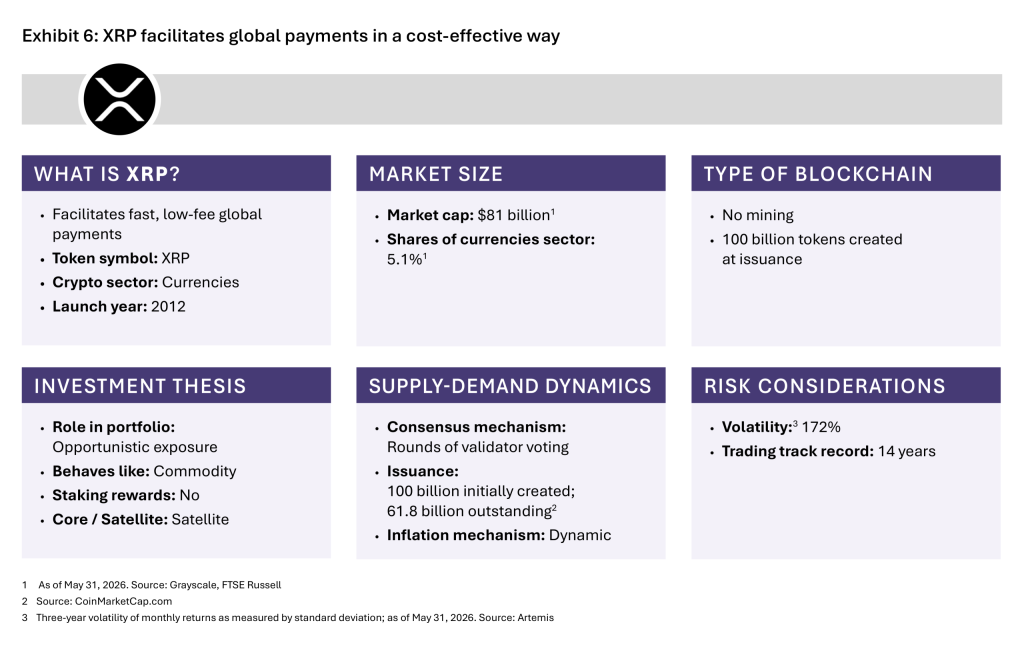
XRP launched in 2012, giving it a 14-year track record. Its trading ticker reflects the token’s name, XRP. As of May 2026, its market cap was $81 billion, about 5.1% of the currencies sector index. It differs from the proof-of-work currencies above: Its entire 100-billion supply was created at launch, with about 61.8 billion outstanding in May 2026. (Previously created tokens are released into circulation averaging 300 million a month.) Because no new tokens are mined, there is no Proof of Work—instead, transactions are approved by rounds of validator voting, run by organizations that benefit from the network’s reliability rather than by token rewards (Exhibit 6).

XRP powers the XRP Ledger (XRPL), an open-source blockchain originally designed for cost-efficient cross-border payments. This is big business: remittances that go through traditional bank channels are both large (~$900 billion annually) and costly—averaging 6.7%—in addition to being relatively slow when compared to the blockchain. XRPL confirms over 1,500 transactions per second, with fees around $0.0002 and finality in 3–5 seconds, offering targeted exposure to the evolution of global payment infrastructure. Adoption is not assured, as stablecoins on smart contract platforms also compete in cross-border payments.

From an allocation perspective, we consider XRP a satellite holding in a digital asset portfolio.

VIII. How to access the tokens in the Currencies sector

There are two primary ways to access digital assets across all sectors: direct ownership and ownership through commingled vehicles.2

Direct ownership means opening an account at a centralized exchange, completing know-your-customer verification, depositing fiat currency, and purchasing the asset. From there, an investor can leave holdings on the exchange or move to self-custody in a personal digital wallet. Commingled vehicles such as exchange-traded products (ETPs), exchange-traded funds (ETFs), and private funds offer exposure through structures investors already know and can be held in existing brokerage or retirement accounts.

Choosing between the two options comes down to a trade-off between control and convenience. We believe that for most investors seeking a diversified portfolio of digital assets, commingled vehicles, particularly ETPs and ETFs, offer the simplest and most operationally efficient way to gain exposure to digital assets, which helps explain the accelerating pace of institutional adoption we have seen recently.

Exhibit 7 details investable vehicle availability for each of the tokens covered in this primer.

1 – As of May 31, 2026. Source: FTSE Russell, Grayscale. https://www.grayscale.com/crypto-sectors
2 – For a detailed explanation, please refer to either the first class of the Digital Asset Investing Fundamentals Course or the first primer of this series. Both are available at https://grayscaleinstitute.com/


Important Information

Investments in digital assets are speculative investments that involve significant risk, including a partial or total loss of invested funds. Investments in digital assets are not suitable for any investor that cannot afford loss of the entire investment.

This material is not intended to be relied upon as a forecast, research, or investment advice, and is not a recommendation, offer or solicitation to buy or sell any securities or to adopt any investment strategy. The opinions expressed may change as subsequent conditions vary. The information and opinions contained in this material are derived from proprietary and nonproprietary sources deemed by Grayscale to be reliable, are not necessarily all-inclusive and are not guaranteed as to accuracy. Past performance is no guarantee of future results. There is no guarantee that any forecasts made will come to pass. Reliance upon information in this material is at the sole discretion of the reader.

You are solely responsible for evaluating and acting upon the education and information contained in this material. Grayscale will not be liable for direct or incidental loss resulting from applying any of the information obtained from these materials or from any other source mentioned. Grayscale does not render any legal, tax or accounting advice and the education and information contained in this material should not be construed as such. Please consult with a qualified professional for these types of advice. Grayscale and its employees may hold certain of the digital assets mentioned herein.

All content is original and has been researched and produced by Grayscale Investments Sponsors, LLC (“Grayscale”) unless otherwise stated herein. No part of this content may be reproduced in any form, or referred to in any other publication, without the express consent of Grayscale.

© 2026 Grayscale. All trademarks, service marks, and/or trade names (e.g., G™, GRAYSCALE®, GRAYSCALE CRYPTO SECTORS™, and GRAYSCALE INVESTMENTS®) are owned and/or registered by Grayscale.

Associated Class

Now On Demand
Understanding Crypto Sectors: Currencies and Smart Contract Platforms
Now On Demand • 1.5 CE Credits

Related Classes

Now On Demand
Understanding Digital Asset Investing
Now On Demand • 1 CE Credit
Now On Demand
Understanding Crypto Sectors: Financials and Utilities & Services
Now On Demand • 1 CE Credit
Live Class
Understanding Crypto Sectors: Artificial Intelligence and Consumer & Culture
Oct 1, 2026 • 11:00AM ET • 1 CE Credit

Archives

  • October 2026
  • September 2026
  • July 2026
  • June 2026
  • May 2026
  • April 2026

Categories

  • Locked
  • No Date
  • Primers
  • The Stack

Stay on top of the latest crypto news and insights

  • Instagram
  • X
  • Facebook
  • LinkedIn
  • YouTube

Helpful Links

  • Login
  • Digital Asset Investing Fundamentals Course
  • The Stack
© Grayscale. All rights reserved
  • Privacy Policy
  • Terms of Service
  • Social Media Disclosure

Investments in digital assets are speculative investments that involve significant risk, including a partial or total loss of invested funds. Investments in digital assets are not suitable for any investor that cannot afford loss of the entire investment.

This information should not be relied upon as research, legal, tax or investment advice, or a recommendation regarding any products, strategies, or any investment in particular. This material is strictly for illustrative, educational, or informational purposes and is subject to change. This content does not constitute an offer to sell or the solicitation of an offer to sell or buy any security in any jurisdiction where such an offer or solicitation would be illegal. There is not enough information contained in this content to make an investment decision and any information contained herein should not be used as a basis for this purpose. Readers are encouraged to seek guidance from qualified professionals.


IMPORTANT: By signing up for a Grayscale event, you acknowledge that your participation, including any travel, lodging, or meals paid for by Grayscale, complies with all applicable laws, regulations, and policies, whether in the United States or abroad. You also confirm that you have completed any required disclosures, obtained necessary approvals, and will meet any reporting obligations related to your attendance.


Grayscale and its employees may hold certain of the digital assets mentioned herein.

Certain of the statements contained herein may be statements of future expectations and other forward-looking statements that are based on Grayscale’s views and assumptions and involve known and unknown risks and uncertainties that could cause actual results, performance, or events to differ materially from those expressed or implied in such statements. In addition to statements that are forward-looking by reason of context, the words “may, will, should, could, can, expects, plans, intends, anticipates, believes, estimates, predicts, potential, projected, or continue” and similar expressions identify forward-looking statements. Grayscale assumes no obligation to update any forward-looking statements contained herein and you should not place undue reliance on such statements, which speak only as of the date hereof. Although Grayscale has taken reasonable care to ensure that the information contained herein is accurate, no representation or warranty (including liability towards third parties), expressed or implied, is made by Grayscale as to its accuracy, reliability, or completeness. You should not make any investment decisions based on these estimates and forward-looking statements.

Specific companies, issuers, platforms, or protocols are mentioned for educational purposes only and should not be deemed a recommendation to buy or sell any securities, digital assets, or other financial instruments. Any entities mentioned do not necessarily represent current or future holdings of any Grayscale products.


All content is original and has been researched and produced by Grayscale Investments Sponsors, LLC (“Grayscale”) unless otherwise stated herein. No part of this content may be reproduced in any form, or referred to in any other publication, without the express consent of Grayscale.


© Grayscale. All trademarks, service marks and/or trade names (e.g., G™, GRAYSCALE®, GRAYSCALE CRYPTO SECTORS™, and GRAYSCALE INVESTMENTS®) are owned and/or registered by Grayscale.