
Key Takeaways
- Utilities & Services is among the smallest crypto sectors by market cap.
- Rather than offering services to consumers, the utilities & services sector focuses on delivering enterprise-level services that facilitate the operation of blockchains and applications.
- Examples of applications in the sector include the provisioning of decentralized physical infrastructure networks (DePIN), oracles & data, liquid staking, wallets & payments, and blockchain interoperability.
- Utilities & Services are typically valued as financial claims using discounted cash flow analysis.
- Representative tokens in the sector include Chainlink and Lido. We consider them both as growth holdings playing a satellite role in digital asset portfolios.
I. What is the Utilities & Services crypto sector?
The utilities & services sector focuses on delivering enterprise-level services that facilitate the operation of blockchains and applications. There are a wide variety of applications in this sector, including decentralized physical infrastructure networks (DePIN), oracles and data, liquid staking, wallets and payments, and blockchain interoperability.
DePIN applications provide peer-to-peer data storage, bandwidth, and computational resources. For example: Helium, which facilitates the decentralized provision of wireless bandwidth and infrastructure.
Oracles and data applications, such as those provided by Chainlink and The Graph, provide real-time data and prices to smart-contract applications.
Liquid staking allows users to earn staking rewards without lockup periods. Lido provides this service on the Ethereum blockchain, while Jito provides it on Solana.
Wallet and payments applications facilitate payments, remittances, and token storage. The Trust Wallet Token, for example, is a governance token for Trust Wallet that provides discounts on decentralized exchange trading.
In the remainder of this primer, we will first dimension this important digital asset sector. Using a consistent template, we will then profile two representative investable tokens—highlighting their market size, investment thesis, and risk considerations—so you can learn and compare them side by side.
II. Sizing the sector
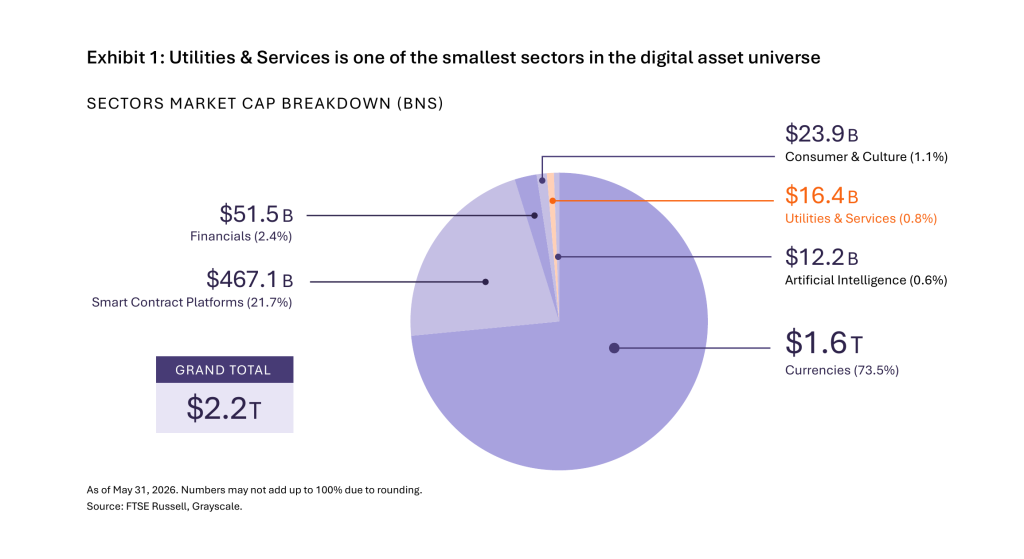
The first step in understanding crypto sectors is to dimension them. Exhibit 1 demonstrates how Utilities & Services is one of the smallest sectors in digital assets by market cap—about 0.8% of the value of all digital assets as measured by the Grayscale Crypto Sector Index—with 30 constituent tokens.1
In the remainder of this primer, we highlight two representative investable tokens in the sector: Chainlink and Lido.
Also, before we continue, a word on key terms and structure. As a companion to the Grayscale Institute’s Digital Asset Investing Fundamentals course, the knowledge in this primer series, like in the course, builds chronologically—this primer inherits knowledge from previous ones. In this light, please refer back to either previous classes (available on demand) or previous primers if you feel like you need a refresher at any time on certain topics, such as wallets or decentralized networks. All materials are available on the Grayscale Institute website.
III. Chainlink: Bringing reliable real-world data onto blockchains
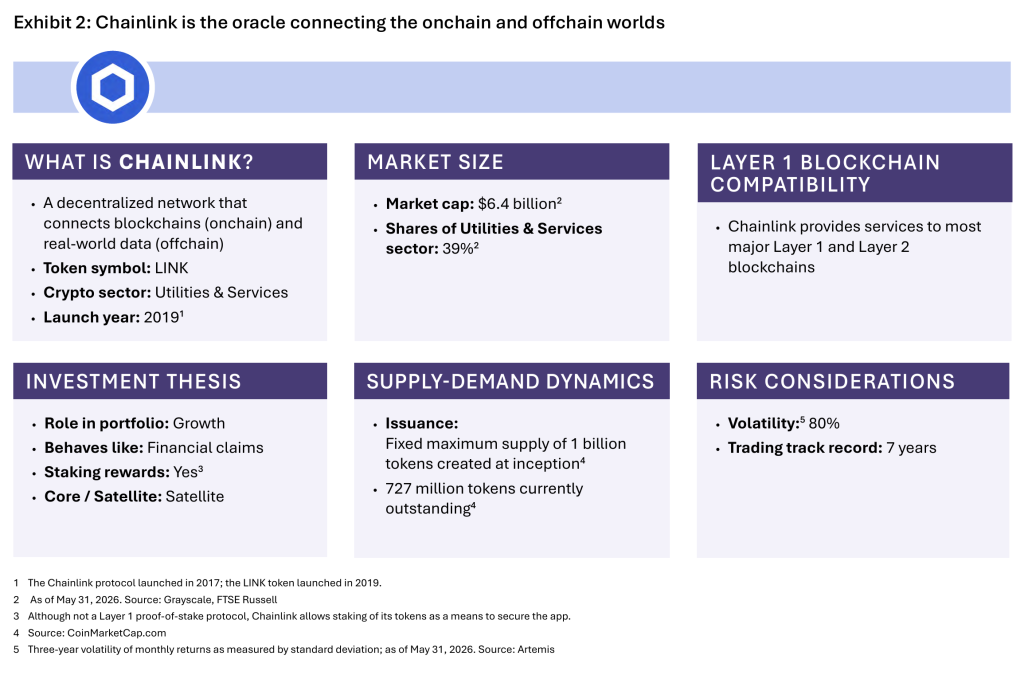
Chainlink is a decentralized network that connects blockchains (onchain) and real-world data (offchain). It is what’s known as an “oracle”—the foundational plumbing behind decentralized finance, linking blockchains to information outside of the blockchain. A decentralized oracle network feeds reliable real-world data—such as prices, reserves, other offchain information—onto blockchains.
Chainlink is not a blockchain, but it provides services to most major Layer 1 and Layer 2 blockchains.
Smart contracts don’t natively have access to real-time prices and data from external sources. This means that the smart contract controlling the operations of a decentralized exchange requires external, real-time pricing information to ensure prices are consistent with global markets. Oracles are deployed broadly across DeFi applications, including lending liquidations, token swaps, derivative markets, risk engines, and tokenization.
Chainlink is widely regarded as the default oracle for decentralized finance, securing major money markets, derivatives, and stablecoins across many chains. Chainlink’s largest customer is Aave, a leading DeFi protocol.
In short, Chainlink is the critical connective tissue between crypto and traditional finance—between the onchain and offchain worlds. Grayscale believes that Chainlink’s suite of software technologies will be central to many blockchain applications, including tokenization and decentralized finance.
From an allocation perspective, we consider Chainlink a growth holding playing a satellite role in digital asset portfolios.
IV. Lido: The largest liquid staking token2
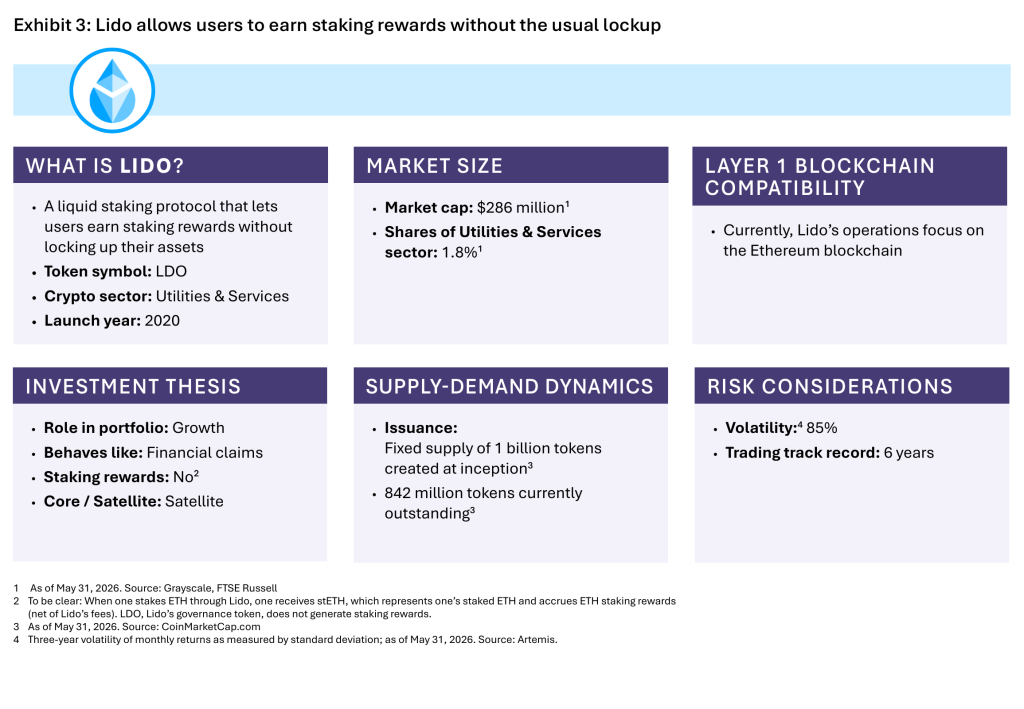
Lido is the largest liquid staking protocol in the digital asset universe. What are liquid staking tokens? They are tokens that allow users to earn staking rewards without the lockup required by traditional staking. In liquid staking, tokens are exchanged 1-for-1 for liquid staking tokens, earning a portion of staking reward while preserving liquidity.
For example, sending Ether to the Lido smart contract returns the same number of Lido’s staked Ether tokens, or stETH. While traditionally staked Ether tokens earn staking rewards, they are locked into the Ether protocol and can’t be used on other DeFi platforms. Liquid staking tokens, on the other hand, can be used as collateral on DeFi platforms, providing liquidity on Uniswap or borrowing on Aave.
Lido is not a blockchain, but an application that primarily runs on Ethereum’s Layer 1 blockchain. Lido is the largest liquid staking protocol and one of the largest DeFi protocols overall, holding over 20% of all staked Ether.3 As a liquid staking protocol that lets users stake ETH while keeping their capital liquid, Lido can improve capital efficiency. While earning staking rewards on Ether assets, staked Ether tokens can be deployed across DeFi platforms, effectively using the same assets twice.
Lido pools ETH deposits from many users and distributes those deposits across a network of professional node operators. 90% of the staking rewards are distributed to depositors, while 10% is retained as a fee, split between node operators and the Lido DAO treasury.4 The Lido DAO5 treasury is managed via the LDO governance token, which holders can use to vote on potential changes to the liquid staking protocol’s operations. A portion of fees is used to buy back LDO tokens, which is the primary mechanism for returning protocol revenue to the value of the LDO token.
From an allocation perspective, we consider Lido a growth holding playing a satellite role in digital asset portfolios.
V. How to access the tokens in the Utilities & Services sector
There are two primary ways to access digital assets across all sectors: direct ownership and ownership through commingled vehicles.6
Direct ownership means opening an account at a centralized exchange, completing know-your-customer verification, depositing fiat currency, and purchasing the asset. From there, an investor can leave holdings on the exchange or move to self-custody in a personal digital wallet. Commingled vehicles such as exchange-traded products (ETPs), exchange-traded funds (ETFs), and private funds offer exposure through structures investors already know and can be held in existing brokerage or retirement accounts.
Choosing between the two options comes down to a trade-off between control and convenience. We believe that for most investors seeking a diversified portfolio of digital assets, commingled vehicles, particularly ETPs and ETFs, offer the simplest and most operationally efficient way to gain exposure to digital assets, which helps explain the accelerating pace of institutional adoption we have seen recently.
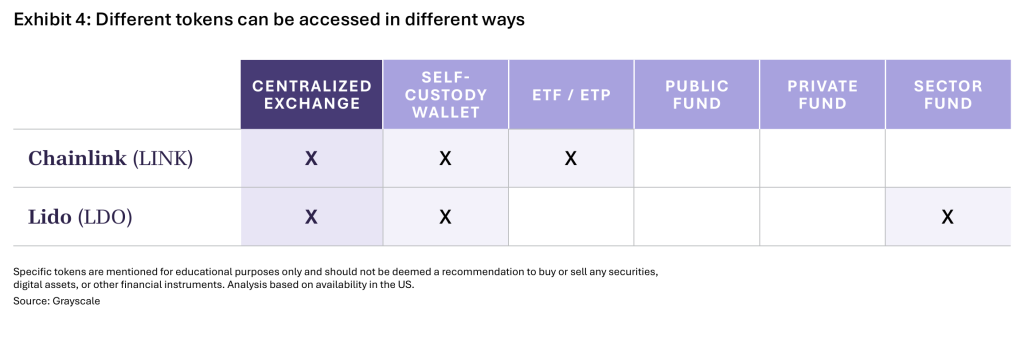
Exhibit 4 details investable vehicle availability for each of the tokens covered in this primer.
1 – As of May 31, 2026. Source: FTSE Russell, Grayscale. https://www.grayscale.com/crypto-sectors
2 – As measured by total value locked, as of July 2026. Source: DeFiLlama
3 – As of May 31, 2026. Source: CoinMarketCap.com
4 – Source: https://lido.fi/how-lido-works/protocol-fee
5 – DAOs are decentralized autonomous organizations, a form of corporate governance that is comparable to real-world corporations but with a flatter, more decentralized structure.
6 – For a detailed explanation, please refer to either the first class of the Digital Asset Investing Fundamentals Course or the first primer of this series. Both are available at https://grayscaleinstitute.com/
Important Information
Investments in digital assets are speculative investments that involve significant risk, including a partial or total loss of invested funds. Investments in digital assets are not suitable for any investor that cannot afford loss of the entire investment.
This material is not intended to be relied upon as a forecast, research, or investment advice, and is not a recommendation, offer or solicitation to buy or sell any securities or to adopt any investment strategy. The opinions expressed may change as subsequent conditions vary. The information and opinions contained in this material are derived from proprietary and nonproprietary sources deemed by Grayscale to be reliable, are not necessarily all-inclusive and are not guaranteed as to accuracy. Past performance is no guarantee of future results. There is no guarantee that any forecasts made will come to pass. Reliance upon information in this material is at the sole discretion of the reader.
You are solely responsible for evaluating and acting upon the education and information contained in this material. Grayscale will not be liable for direct or incidental loss resulting from applying any of the information obtained from these materials or from any other source mentioned. Grayscale does not render any legal, tax or accounting advice and the education and information contained in this material should not be construed as such. Please consult with a qualified professional for these types of advice. Grayscale and its employees may hold certain of the digital assets mentioned herein.
All content is original and has been researched and produced by Grayscale Investments Sponsors, LLC (“Grayscale”) unless otherwise stated herein. No part of this content may be reproduced in any form, or referred to in any other publication, without the express consent of Grayscale.
© 2026 Grayscale. All trademarks, service marks, and/or trade names (e.g., G™, GRAYSCALE®, GRAYSCALE CRYPTO SECTORS™, and GRAYSCALE INVESTMENTS®) are owned and/or registered by Grayscale.