
Key Takeaways
- Financials is the third largest crypto sector. The most prominent protocols in the sector are decentralized finance (DeFi) platforms, which aim to provide financial services without centralized counterparties.
- There are four key DeFi applications, including decentralized exchanges, borrowing & lending, derivative markets, and stablecoins.
- Among crypto sectors, DeFi platforms generate the lion’s share of fees. Since the start of 2023, DeFi protocols have generated nearly $25 billion in cumulative fees.
- Financials are typically valued as financial claims using discounted cash-flow analysis.
- Representative tokens in the sector include Aave, Hyperliquid, and Uniswap. We consider them satellite holdings in a digital asset portfolio.
I. What is the Financials crypto sector?
In essence, the Grayscale Financials Crypto Sector focuses on decentralized finance (DeFi), which aims to provide financial services without centralized counterparties. There are four key applications of decentralized finance:
- Decentralized exchanges, which exchange crypto assets on an automated platform.
- Borrowing and lending platforms, which allow users to borrow against crypto collateral or earn rewards.
- Derivative markets, which facilitate the trading of options and perpetual futures.
- Stablecoins, which provide access to US Dollars and Euros at low volatility in tokenized form.
The leading DeFi platforms generate substantial fees. DeFi protocols facilitate trading, borrowing, lending, collateral management, liquidity provisioning, risk transfer, and much more. Many of these protocols are large and growing organizations, with activity driven primarily by decentralized exchanges, liquid staking, lending, and derivatives.
Since the beginning of 2023, DeFi protocols have generated nearly $25 billion in cumulative fees.1 Many leading DeFi protocols also exhibit attractive operating characteristics, including high gross margins, limited capital expenditure requirements, and scalable software-driven business models.
Many of these protocols have substantial valuations, and investors use traditional discounted cash-flow modeling to value their tokens. While cash is not paid to token holders as dividends in most cases, many protocols use operating cash flows to buy back tokens on the open market. When valued on a price-to-cash-flow or a price-to-earnings basis, some DeFi tokens are competitively priced relative to publicly traded stocks in the financial or technology sectors.
In the remainder of this primer, we will first dimension this important digital asset sector. Using a consistent template, we will then profile three representative investable tokens—highlighting their market size, investment thesis, and risk considerations—so you can learn and compare them side by side. Finally, we will focus on stablecoins, and the important role they play in the digital asset universe.
II. Sizing the sector
The first step in understanding crypto sectors is to dimension them. Exhibit 1 shows that Financials is the third largest sector in digital assets by market cap—accounting for about 2.4% of the value of all digital assets as measured by the Grayscale Crypto Sector Index—with 45 constituent tokens.2
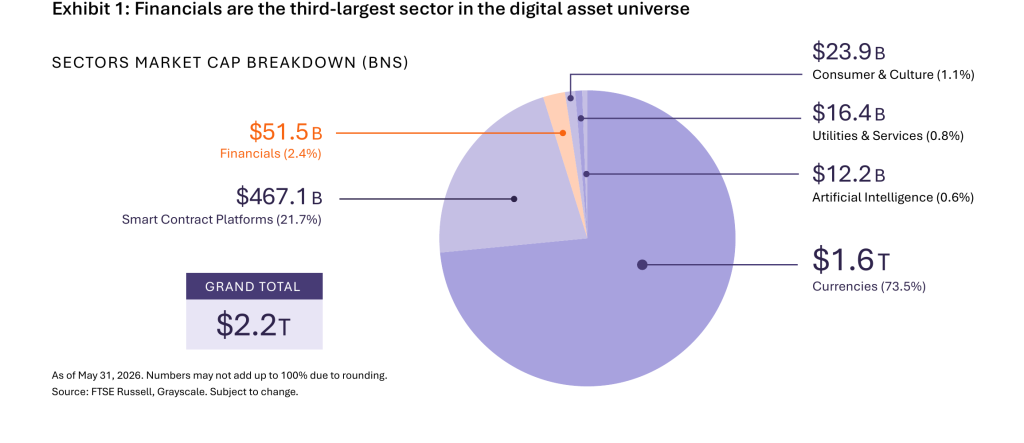
In the remainder of this primer, we highlight three representative investable tokens in the sector: Aave, Hyperliquid, and Uniswap.
Also, before we continue, a word on key terms and structure. As a companion to the Grayscale Institute’s Digital Asset Investing Fundamentals course, the knowledge in this primer series, like in the course, builds chronologically—this primer inherits knowledge from the previous ones. In this light, please refer back to either previous classes (available on demand) or previous primers if you feel like you need a refresher at any time on certain topics, such as centralized versus decentralized ledgers, or our asset valuation approach by behavior (commodity or financial claims). All materials are available on the Grayscale Institute website.
III. Aave: An onchain alternative to traditional banks
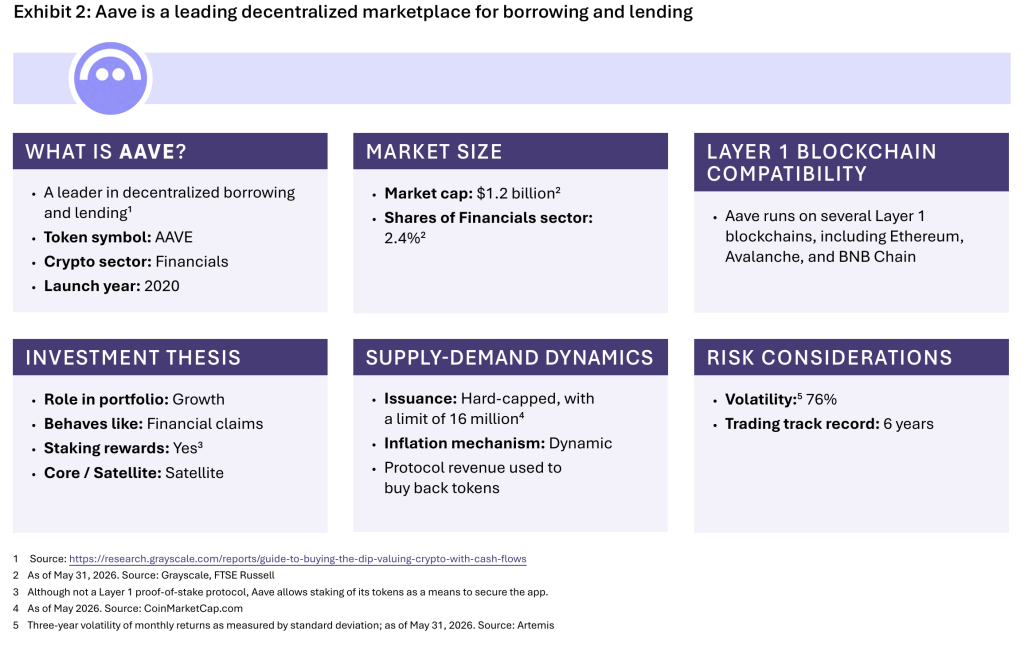
Aave is a decentralized borrowing and lending protocol. It allows users to supply crypto assets to earn rewards and borrow against the collateral they post. Rather than relying on a traditional intermediary, Aave uses smart contracts to pool liquidity, set borrowing terms, manage collateral, and liquidate undercollateralized positions when necessary.
Aave is a decentralized application, not a Layer 1 blockchain. As an application, it is compatible with several Layer 1 blockchains, including Ethereum, Avalanche, and BNB Chain.
In this model, depositors provide the funding base (for example, Ether or a stablecoin), borrowers create demand for credit, and the protocol earns revenue from interest spreads, fees, and related services.
While nuances exist, Aave is often described as a “permissionless onchain bank.” This makes Aave one of the clearest DeFi analogs to a traditional financial company: It facilitates credit creation, generates recurring protocol revenue, and increasingly uses governance-approved mechanisms to return a portion of that economic value to AAVE token holders.
Rather than handing assets to a company, Aave’s depositors interact directly with smart contracts on a non-custodial basis. Onchain credit creation is one of the most fundamental elements of the DeFi ecosystem. With over $59 billion in deposits and $25 billion in loans outstanding across all DeFi, onchain credit unlocks a broad range of opportunities.3 Aave is the clear market leader,4 driving a significant share of total deposits, outstanding loans, and user activity.
Aave is also pushing into real-world assets via its Horizon platform, a dedicated institutional market enabling participants to access DeFi liquidity using tokenized real-world assets as collateral. By bridging traditional capital markets with the Aave protocol, Horizon represents a significant potential source of incremental loan growth.
Aave can be valued as a financial claim due to its substantial net income from fees and net interest margin. From an allocation perspective, we see Aave as a growth asset (due to its strong revenue-generating model) playing a satellite role in digital asset portfolios.
IV. Hyperliquid: The largest decentralized perpetual futures exchange5
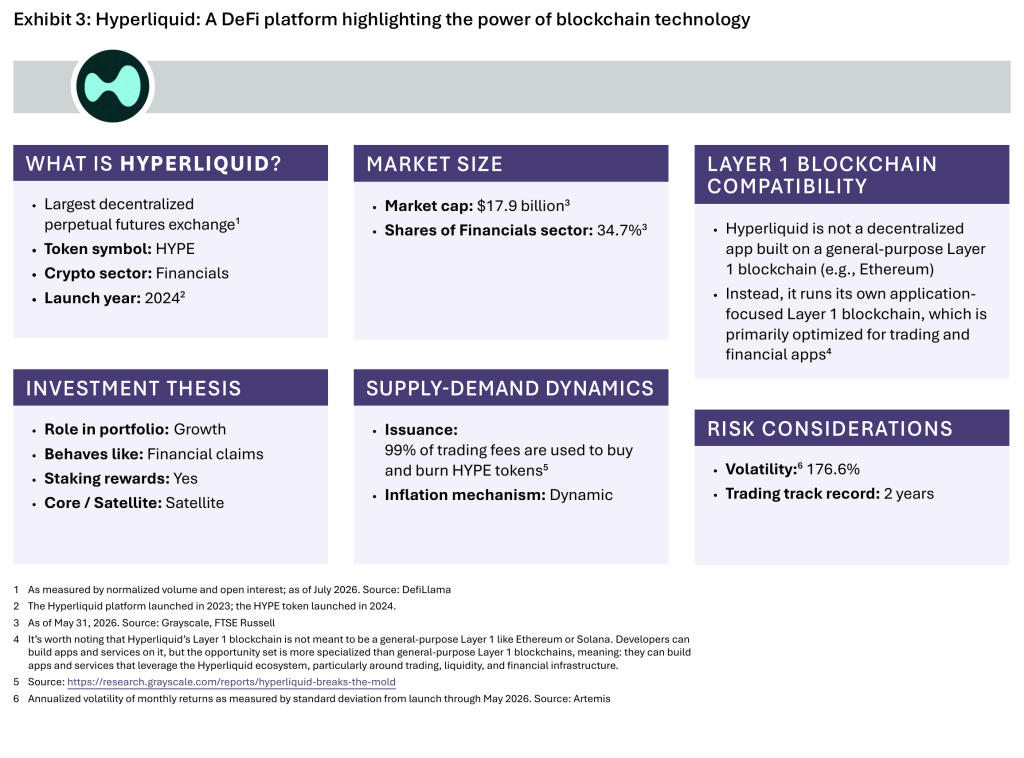
Hyperliquid is the world’s largest decentralized perpetual futures exchange. Perpetual futures, for their part, are one of the fastest-growing parts of the crypto universe. So-called “perps” contracts allow traders to take long-term positions without the monthly or quarterly expirations of traditional futures contracts. They are big business: Trading volume in these instruments reached $61.7 trillion in 2025.6 Most of that was dominated by centralized exchanges such as Binance, OKX, and Bybit. And then there is Hyperliquid: the first decentralized, blockchain-based project to capture a meaningful share of trading volume and open interest in this market.
Hyperliquid is not a decentralized app built on a general-purpose Layer 1 blockchain like Ethereum. Instead, it runs its own application-focused Layer 1 blockchain, which is primarily optimized for trading and financial apps. That is, applications can be built on the Hyperliquid blockchain, but they must focus on the Hyperliquid ecosystem’s goals of supporting trading, liquidity, and financial infrastructure.
Traditional futures have an expiration date. At the regular monthly or quarterly expiration of each contract, the spot price must equal the futures price. In contrast, because perpetual futures never expire, perpetual futures use a funding rate, which is paid at least every eight hours. When funding rates are positive, traders with long positions pay those with short positions. When funding rates are negative, the shorts pay those with long positions.
Perpetual futures in crypto markets have been hugely successful, with trading volumes typically exceeding volume in the unleveraged spot market by more than five times. Hyperliquid processed $2.9 trillion in perp volume in 2025 and recently held about $7 billion in open interest.7 When measured by open interest, Hyperliquid is the largest decentralized perpetual futures exchange and is among the top three largest perpetual futures exchanges generally. Hyperliquid’s volume, open interest, fees, and mindshare have all grown together, even as the platform has begun expanding from crypto-native markets toward a broader set of tradable exposures.
In offshore markets, perpetual futures can be accessed with significant leverage. In the more tightly regulated US and European markets, leverage is limited to lower levels relative to investors’ capital. It’s important to note that due to regulatory uncertainty about decentralized exchanges, US regulations currently prevent domestic investors from accessing the Hyperliquid platform. But this backdrop is shifting quickly. In early 2026, the CFTC approved the first perpetual futures products for regulated platforms. Grayscale expects that regulatory clarity will eventually allow users to access perps through decentralized onchain trading platforms like Hyperliquid.
Hyperliquid has also expanded beyond perps to other products using an open-architecture approach. New functionality is typically introduced through Hyperliquid Improvement Proposals, or HIPs, and the products are deployed by third-party builders. HIP-3, for example, enables “permissionless” deployment of any asset as a perpetual—including tokenized assets like gold and equities. In other words, it is effectively competing with products offered by traditional futures and options exchanges, such as futures on the S&P 500 Index, gold, and oil. These new markets have proven hugely popular with users and have begun to function as off-hours price-discovery venues for traditionally traded assets. For its part, HIP-4 introduces outcome markets for event-based and prediction trading.
From an allocation perspective, we consider Hyperliquid a growth asset playing a satellite role in a digital asset portfolio.
V. Uniswap: The leading decentralized exchange for onchain spot trading8
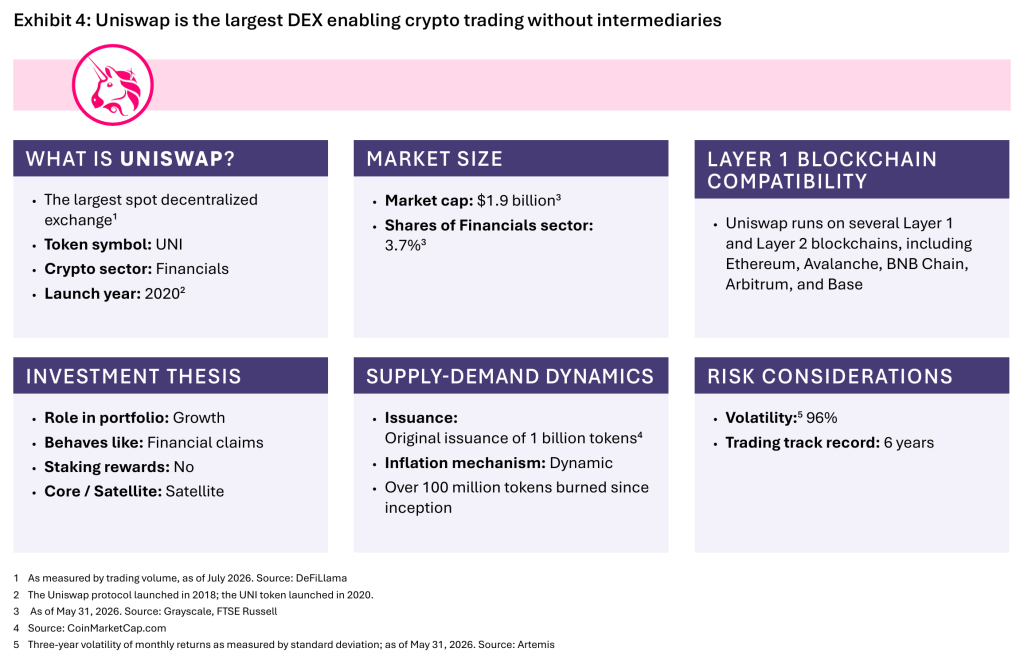
Uniswap is the largest decentralized exchange for onchain spot trading. It allows investors anywhere in the world to trade digital money directly from their own wallets without an intermediary, such as a bank or brokerage firm.
Crypto venues primarily fall into two categories: centralized exchanges, or CEXs, and decentralized exchanges, or DEXs.
CEXs are traditional businesses that operate with custody and trade matching offchain, providing nearly instantaneous settlement through their internal ledgers. Users experience a settlement delay when moving assets off the platform into a traditional bank account.
DEXs, by contrast, are smart contract-based applications deployed on a blockchain that enable users to transact directly from self-custodied wallets. When trading on a DEX, execution and settlement occur within a single blockchain confirmation, typically taking only seconds.
Uniswap is a decentralized exchange that lets users swap tokens directly from their wallets without an intermediary. It runs on several Layer 1 blockchains, including Ethereum, Avalanche, and BNB Chain.
DEXs primarily use two types of trading architectures: automated market makers and central limit order books. Automated market makers, or AMMs, provide liquidity through pools that passively offer quotes based on predefined mathematical curves, such as Uniswap v3’s concentrated liquidity model. AMMs excel at efficiently serving long-tail asset swaps or stablecoin pairs, particularly on blockchains with limited capacity. Through AMMs, users can become liquidity providers by depositing tokens into pools and earning a share of swap fees. Open, permissionless liquidity is the core innovation that most of DeFi still builds on.
In short, Uniswap allows anyone to be a liquidity provider or participate in decentralized spot trading. Users simply send tokens to Uniswap’s smart contract with a request for which token they would like in return. Without taking custody of the user’s assets, Uniswap makes the token swap and returns the new tokens to the user’s self-custody wallet.
From an allocation perspective, we consider Uniswap a growth asset playing a satellite role in a digital asset portfolio.
VI. How to access the tokens in the Financials sector
There are two primary ways to access digital assets across all sectors: direct ownership and ownership through commingled vehicles.9
Direct ownership means opening an account at a centralized exchange, completing know-your-customer verification, depositing fiat currency, and purchasing the asset. From there, an investor can leave holdings on the exchange or move to self-custody in a personal digital wallet. Commingled vehicles such as exchange-traded products (ETPs), exchange-traded funds (ETFs), and private funds offer exposure through structures investors already know and can be held in existing brokerage or retirement accounts.
Choosing between the two options comes down to a trade-off between control and convenience. We believe that for most investors seeking a diversified portfolio of digital assets, commingled vehicles, particularly ETPs and ETFs, offer the simplest and most operationally efficient way to gain exposure to digital assets, which helps explain the accelerating pace of institutional adoption we have seen recently.
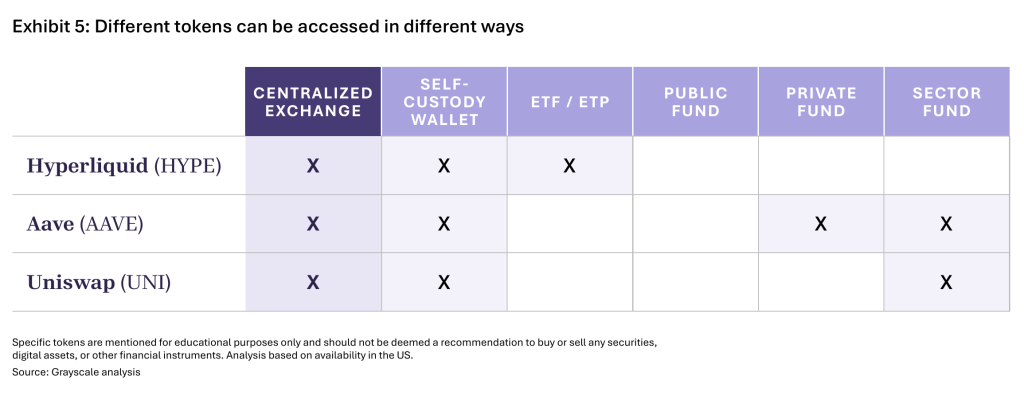
Exhibit 5 details investable vehicle availability for each of the tokens covered in this primer.
VII. Stablecoins: A digital asset success story
Stablecoins are digital assets designed to track the value of a fiat currency, such as the US Dollar, with minimal volatility. In essence, they were the first—and are still the largest—tokenized assets. As a reminder, tokenized assets are those that represent real-world assets, including currencies, Treasuries, stocks, gold, and investment funds, and make them available in digital form that can be accessed and traded onchain.
Traditional markets trade only during weekday business hours and are available only to investors in certain countries. Through tokenization, these assets become tradable 24/7 with broader availability to investors worldwide. The ownership of tokenized assets—including stablecoins—is tracked and secured by blockchains such as Ethereum, BNB Chain, and Solana. Stablecoins and other tokenized assets generate trading volume and fee income for these Layer 1 blockchains.
The use cases for stablecoins are many, including:
- A store of value for investors desiring the stability of a hard fiat currency—US Dollar, Euro—rather than their home country’s currency.
- An efficient bridge between fiat currency and digital assets, facilitating on- and off-ramping between the two ecosystems.
- Stable collateral that can be used to access decentralized financial services.
- Holding liquidity while waiting to reinvest the proceeds of crypto transactions.
- Global payments, which enable fast, low-cost money transfers.
Stablecoins are a big business, with 11.4% of all crypto assets invested in the two largest US Dollar stablecoins: Tether’s USDT, with $186 billion10 in outstanding tokens, and Circle’s USDC, with $75 billion11 in outstanding tokens.
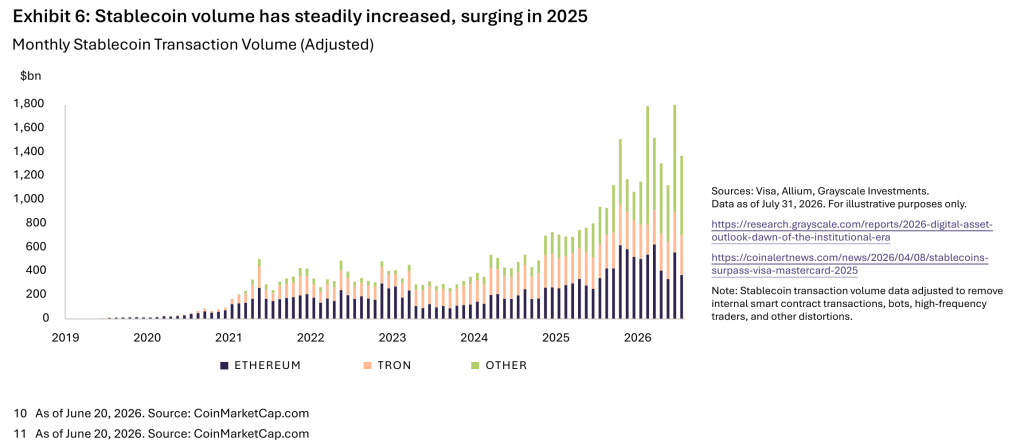
As shown in Exhibit 6, global monthly stablecoin transaction volume reached $1 trillion by the end of 2025. Regulatory clarity from the US GENIUS Act may have contributed to volume growth.
The prohibition on yield for US regulated payment stablecoins makes issuing these instruments potentially a highly profitable business. Stablecoin reserves are invested in Treasuries and bank deposits, with yield earned by the issuer and not the token holders. That is, buyers of stablecoins are making interest-free loans to stablecoin issuers, who can reinvest the proceeds at interest rates that, at the time of this writing, are paying near 4% annually.
The world’s largest stablecoin is USDT. Tether, the issuer of USDT, earned net profits of more than $10 billion in 2025 with fewer than 450 employees. To back the outstanding stablecoins, Tether holds $192 billion in assets, including $122 billion in US Treasury assets.12 These Treasury holdings rank among the largest 20 global Central Bank holdings.13
While Tether and Circle are today’s leading US Dollar stablecoins, there are relatively low barriers to entry for entities already regulated within the banking system. Due to the extraordinary potential profitability of the stablecoin business, new players are expected to enter the market. One of the newest and potentially largest entrants is the Open Standard stablecoin, Open USD (OUSD). Supported by 140 companies, including Visa, Mastercard, Coinbase, IBM, BNY, and Google, the new stablecoin is expected to debut in 2026.
1 – Source: https://research.grayscale.com/reports/guide-to-buying-the-dip-valuing-crypto-with-cash-flows
2 – As of May 31, 2026. Source: FTSE Russell, Grayscale. https://www.grayscale.com/crypto-sectors
3 – https://research.grayscale.com/reports/guide-to-buying-the-dip-valuing-crypto-with-cash-flows
4 – https://research.grayscale.com/reports/guide-to-buying-the-dip-valuing-crypto-with-cash-flows
5 – As measured by normalized volume and open interest; as of July 2026. Source: DefiLlama
6 – Source: CryptoQuant
7 – Source: CoinGecko.com
8 – As measured by trading volume, as of July 2026. Source: DeFiLlama
9 – For a detailed explanation, please refer to either the first class of the Digital Asset Investing Fundamentals Course or the first primer of this series. Both are available at https://grayscaleinstitute.com/
10 – As of June 20, 2026. Source: CoinMarketCap.com
11 – As of June 20, 2026. Source: CoinMarketCap.com
12 – Source for all Tether data: https://tether.io/news/tether-delivers-10b-profits-in-2025-6-3b-in-excess-reserves-and-record-141-billion-exposure-in-u-s-treasury-holdings/
13 – Source: https://ticdata.treasury.gov/resource-center/data-chart-center/tic/Documents/slt_table5.html
Important Information
Investments in digital assets are speculative investments that involve significant risk, including a partial or total loss of invested funds. Investments in digital assets are not suitable for any investor that cannot afford loss of the entire investment.
This material is not intended to be relied upon as a forecast, research, or investment advice, and is not a recommendation, offer or solicitation to buy or sell any securities or to adopt any investment strategy. The opinions expressed may change as subsequent conditions vary. The information and opinions contained in this material are derived from proprietary and nonproprietary sources deemed by Grayscale to be reliable, are not necessarily all-inclusive and are not guaranteed as to accuracy. Past performance is no guarantee of future results. There is no guarantee that any forecasts made will come to pass. Reliance upon information in this material is at the sole discretion of the reader.
You are solely responsible for evaluating and acting upon the education and information contained in this material. Grayscale will not be liable for direct or incidental loss resulting from applying any of the information obtained from these materials or from any other source mentioned. Grayscale does not render any legal, tax or accounting advice and the education and information contained in this material should not be construed as such. Please consult with a qualified professional for these types of advice. Grayscale and its employees may hold certain of the digital assets mentioned herein.
All content is original and has been researched and produced by Grayscale Investments Sponsors, LLC (“Grayscale”) unless otherwise stated herein. No part of this content may be reproduced in any form, or referred to in any other publication, without the express consent of Grayscale.
© 2026 Grayscale. All trademarks, service marks, and/or trade names (e.g., G™, GRAYSCALE®, GRAYSCALE CRYPTO SECTORS™, and GRAYSCALE INVESTMENTS®) are owned and/or registered by Grayscale.