
Key Takeaways
- Consumer & Culture is among the smallest crypto sectors by market cap.
- The sector covers applications from creative industries such as entertainment, music, media, collectibles, sports, and art.
- We consider its main subsectors to be gaming & metaverse, NFT platforms, media & entertainment, and consumer goods & services.
- Representative tokens in the sector include Dogecoin and Flow. We see them as satellite holdings in a digital asset portfolio.
I. What is the Consumer & Culture crypto sector?
This is perhaps the most intuitive crypto sector for investors to understand, as it largely covers industries we were well familiar with before the rise of digital assets. For example:
- Gaming & Metaverse crypto enterprises verify and allow the transfer of ownership of items and identity in video games and virtual worlds.
- NFT Platforms mint and track ownership of culture-based non-fungible assets, such as collectibles and digital art.
- Media & Entertainment platforms support decentralized music and video content.
- Consumer Goods & Services-focused crypto enterprises help leading brands engage with consumers with NFT-based loyalty programs.
In the remainder of this primer, we will first dimension this important digital asset sector. Then, using a consistent template, we will profile two representative investable tokens—highlighting their market size, investment thesis, and risk considerations—so you can learn and compare them side by side. We will close with information on how to gain access to these investments.
II. Sizing the sector
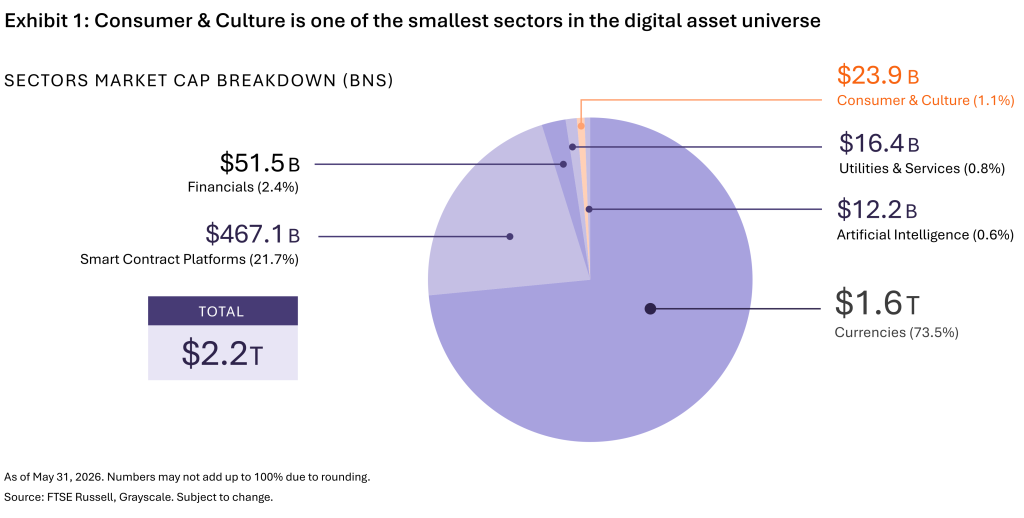
The Consumer & Culture sector is relatively modest in size. As shown in Exhibit 1, it is one of the smallest sectors in digital assets by market cap—about 1.1% of the value of all digital assets as measured by the Grayscale Crypto Sector Index—with 21 constituent tokens.1
In the following chapters, we will highlight two representative investable tokens in the sector: Dogecoin and Flow, as well as a discussion on NFTs.
Also, before we continue, a word on key terms and structure. As a companion to the Grayscale Institute’s Digital Asset Investing Fundamentals course, the knowledge in this primer series, like in the course, builds chronologically—this primer inherits knowledge from previous ones. In this light, please refer back to either previous classes (available on demand) or previous primers if you feel like you need a refresher at any time on certain topics, such as digital wallets, decentralized networks, and proof-of-work and proof-of-stake blockchains. All materials are available on the Grayscale Institute website.
III. Dogecoin: A joke about a dog that became a big deal
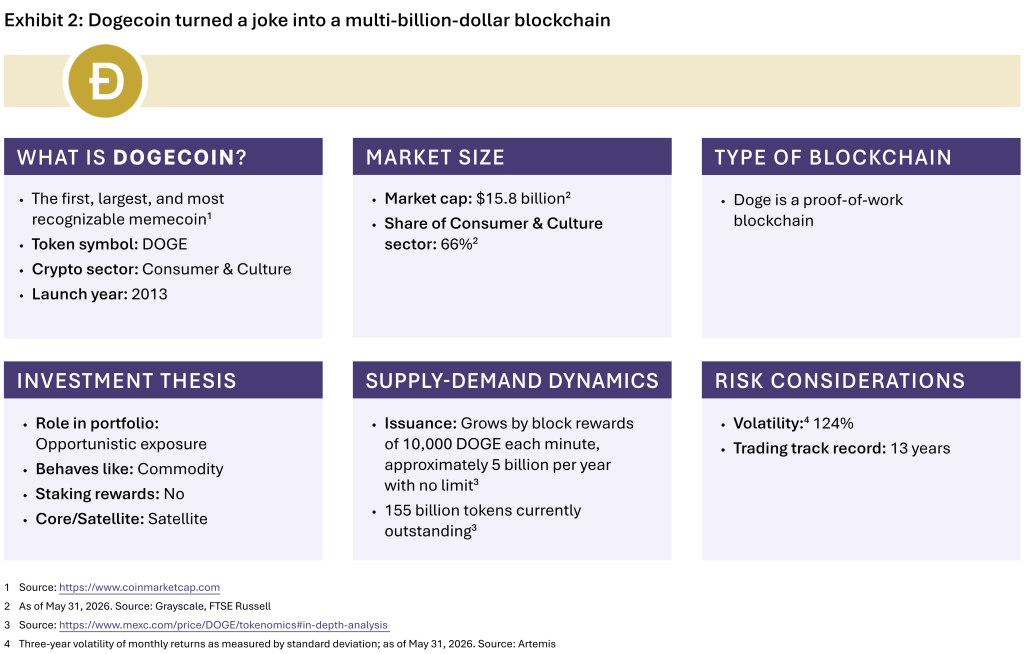
Dogecoin is the token with the largest market capitalization in the Consumer & Culture sector. It trades under the symbol DOGE. At a recent market capitalization of $15.8 billion, Dogecoin accounts for 66% of Grayscale’s Consumer & Culture sector.
An intentional misspelling of the word “dog,” doge refers to a popular viral internet meme featuring a photograph of a Shiba Inu dog making a side-glance expression. Dogecoin uses the Shiba Inu dog as its logo, and it is the largest and most recognizable memecoin in the world.
Memecoins are crypto assets whose value is primarily driven by community, internet culture, and social coordination rather than traditional cash flows. As a result, they represent one of crypto’s clearest examples of price driven by attention and sentiment, not utility or fee generation.
Anything that is popular or viral online can lead to the creation of a memecoin. The vast majority of memecoin market capitalization is tied to animal-themed coins, including dogs, cats, and frogs. Memecoins can serve as a high-beta expression of crypto market sentiment and have historically outperformed during periods of strong retail participation. Despite limited intrinsic utility, the category has demonstrated surprising durability, with leading assets maintaining multi-billion-dollar market capitalizations across cycles.
DOGE operates on its own proof-of-work blockchain. As a result, it does not offer staking rewards and, we believe, should be valued like a commodity.
Dogecoin’s simple design, strong brand recognition, and widespread exchange support have helped it maintain relevance across multiple market cycles. The asset has benefited significantly from endorsements and public commentary by Elon Musk, who has frequently promoted Dogecoin as a practical internet-native currency. Partly as a result, Dogecoin remains one of the most liquid crypto assets globally and serves as a bellwether for retail participation and risk appetite in crypto markets.
On DOGE’s supply: There are currently 155 billion tokens outstanding, with new issuance of 10,000 tokens in each minute’s block reward. Approximately five billion new DOGE tokens are issued annually, and there is no limit on issuance or plans to reduce tokens outstanding through buy or burn programs.
From an allocation perspective, we consider Dogecoin an opportunistic-exposure, commodity-like asset playing a satellite role in digital asset portfolios.
IV. Understanding Non-Fungible Tokens (NFTs)
Fungible assets are exchangeable: consider US Dollars, Bitcoin, or Ether tokens. All three are examples of fungible assets, which are interchangeable and of equal value, meaning that investors don’t care which specific Dollar bill or Bitcoin token they receive. Fungible assets are also divisible, where we can easily spend $13.52 or purchase 0.067 bitcoin.
In contrast, non-fungible tokens, or NFTs, are indivisible blockchain-based digital assets that carry unique attributes. The provenance and ownership history of each NFT is recorded onchain. NFTs can track ownership of real-world assets, such as property titles and automobile registrations.
In the context of the Consumer & Culture sector, NFTs have introduced a new model for digital ownership, enabling creators to monetize content directly and giving users verifiable ownership of internet-native assets. These NFTs represent unique ownership of items such as art, collectibles, gaming assets, intellectual property, and digital identities.
Beyond collectibles, NFT technology is increasingly being explored for applications including gaming, ticketing, and loyalty programs.
V. Flow: Building the infrastructure for digital ownership
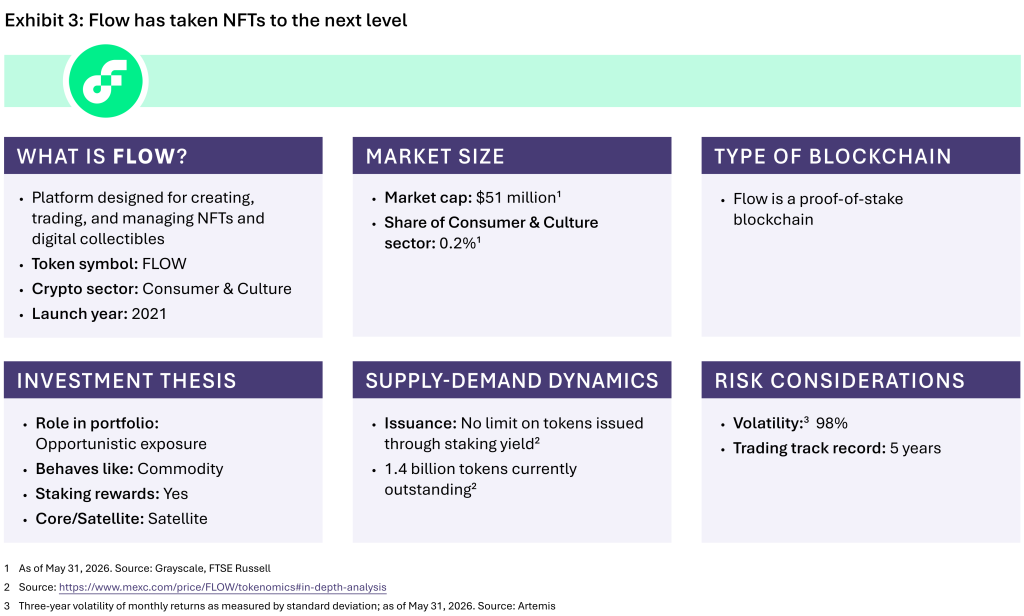
Flow is a platform designed for creating, trading, and managing NFTs and digital collectibles. It launched in 2021, and its token trades under the symbol FLOW. As a proof-of-stake blockchain, FLOW offers staking rewards. The token functions mechanically as a digital commodity within its own ecosystem.
Flow is a Layer 1 blockchain originally developed by Dapper Labs, the team behind CryptoKitties and NBA Top Shot. It was purpose-built for consumer applications and digital collectibles. NFTs created on the Flow blockchain can be traded on major NFT platforms, including OpenSea.
The platform has established partnerships with major consumer brands and sports leagues, including the NBA, NFL, Mattel’s Hot Wheels, Disney Pinnacle, and UFC. The Flow blockchain can support millions of transactions, a quality important to a company like Ticketmaster, which relies on it to provide verifiable digital tickets.
While initially known for NFTs and collectibles, Flow has now also expanded into gaming, consumer applications, digital identity, and broader Web3 infrastructure. FLOW is the native asset used for transaction fees, staking, network security, and governance across the ecosystem.
From an allocation perspective, we consider Flow an opportunistic-exposure, commodity-like asset playing a satellite role in digital asset portfolios.
VI. How to access the tokens in the Consumer & Culture sector
There are two primary ways to access digital assets across all sectors: direct ownership and ownership through commingled vehicles.2
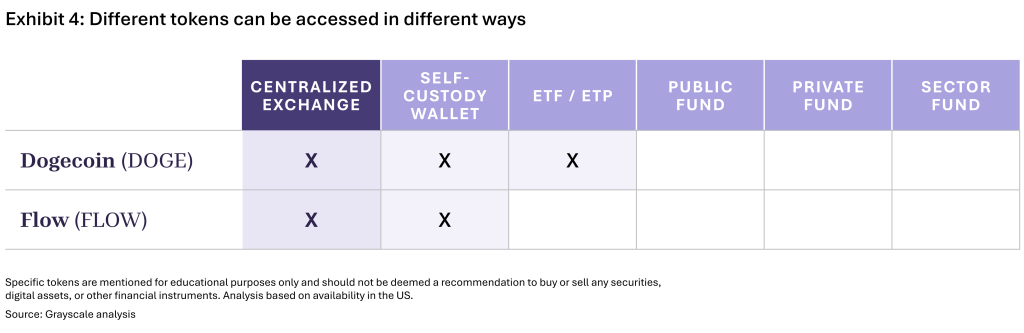
Direct ownership means opening an account at a centralized exchange, completing know-your-customer verification, depositing fiat currency, and purchasing the asset. From there, an investor can leave holdings on the exchange or move to self-custody in a personal digital wallet. Commingled vehicles such as exchange-traded products (ETPs), exchange-traded funds (ETFs), and private funds offer exposure through structures investors already know and can be held in existing brokerage or retirement accounts.
Choosing between the two options comes down to a trade-off between control and convenience. We believe that for most investors seeking a diversified portfolio of digital assets, commingled vehicles, particularly ETPs and ETFs, offer the simplest and most operationally efficient way to gain exposure to digital assets, which helps explain the accelerating pace of institutional adoption we have seen recently.
Exhibit 4 details investable vehicle availability for each of the tokens covered in this primer.
1 – As of May 31, 2026. Source: FTSE Russell, Grayscale. See https://www.grayscale.com/crypto-sectors
2 – For a detailed explanation, please refer to either the first class of the Digital Asset Investing Fundamentals Course or the first primer of this series. Both are available at https://grayscaleinstitute.com/
Important Information
Investments in digital assets are speculative investments that involve significant risk, including a partial or total loss of invested funds. Investments in digital assets are not suitable for any investor that cannot afford loss of the entire investment.
This material is not intended to be relied upon as a forecast, research, or investment advice, and is not a recommendation, offer or solicitation to buy or sell any securities or to adopt any investment strategy. The opinions expressed may change as subsequent conditions vary. The information and opinions contained in this material are derived from proprietary and nonproprietary sources deemed by Grayscale to be reliable, are not necessarily all-inclusive and are not guaranteed as to accuracy. Past performance is no guarantee of future results. There is no guarantee that any forecasts made will come to pass. Reliance upon information in this material is at the sole discretion of the reader.
You are solely responsible for evaluating and acting upon the education and information contained in this material. Grayscale will not be liable for direct or incidental loss resulting from applying any of the information obtained from these materials or from any other source mentioned. Grayscale does not render any legal, tax or accounting advice and the education and information contained in this material should not be construed as such. Please consult with a qualified professional for these types of advice. Grayscale and its employees may hold certain of the digital assets mentioned herein.
All content is original and has been researched and produced by Grayscale Investments Sponsors, LLC (“Grayscale”) unless otherwise stated herein. No part of this content may be reproduced in any form, or referred to in any other publication, without the express consent of Grayscale.
© 2026 Grayscale. All trademarks, service marks, and/or trade names (e.g., G™, GRAYSCALE®, GRAYSCALE CRYPTO SECTORS™, and GRAYSCALE INVESTMENTS®) are owned and/or registered by Grayscale.