
Key Takeaways
- Artificial Intelligence is the smallest crypto sector by market cap.
- Companies in the sector are focused on digital assets related to the development, support, or application of artificial intelligence technology.
- Examples of applications in the sector include AI platforms, which are used to develop blockchain-based AI apps; AI tools & resources, which provide data and computing resources for AI development; and AI apps and agents, which develop apps for verifying identity, building agents, and calculating sentiment analysis.
- Representative tokens in the sector include Bittensor, NEAR, and World. We consider them growth assets that can play a satellite role in a digital asset portfolio.
I. What is the Artificial Intelligence crypto sector?
To understand the Artificial Intelligence crypto sector, we first need to differentiate between centralized and decentralized models.
Centralized models—represented by widely known providers such as OpenAI, Anthropic, Google, and SpaceX—are, as the name implies, developed, tested, and trained centrally, most often using proprietary technology created by individual companies. These models carry benefits, especially their ease-of-use and broad availability to users. These large companies are spending hundreds of billions of dollars to build frontier models, with the potential to revolutionize work, especially through streamlining repetitive tasks.
By accelerating access to knowledge, workers are freed to spend a greater portion of their time on creative and thoughtful tasks. However, we believe that there is a downside to the big-tech AI models, as power, data, and decision-making become increasingly concentrated among a small number of large technology companies.
In contrast, decentralized AI distributes some combination of computing, models, data, governance, and/or economic incentives across independent participants, using open networks and, quite often, blockchain technology to coordinate development, contributions, and rewards.
Further, decentralized AI provides the infrastructure, resources, and applications needed to build, train, and operate AI systems in a more transparent, accessible, and economically aligned way. As with decentralized finance, which seeks to reduce dependencies on unnecessary middlemen, decentralized AI seeks to democratize the development and ownership of artificial intelligence by replacing centralized control with open, blockchain-based networks.
Rather than relying on hyperscalers owning the entire value chain for AI models, decentralized AI leverages unused global computing capacity, allowing users to monetize their contribution to the ecosystem.
In the remainder of this primer, we will first dimension this important digital asset sector. Using a consistent template, we will then profile three representative investable tokens—highlighting their market size, investment thesis, and risk considerations—so you can learn and compare them side by side. We will close with a discussion on how crypto hardware infrastructure, particularly that of Bitcoin miners, is playing a growing role in powering the continued advance of AI going forward.
II. Sizing the sector
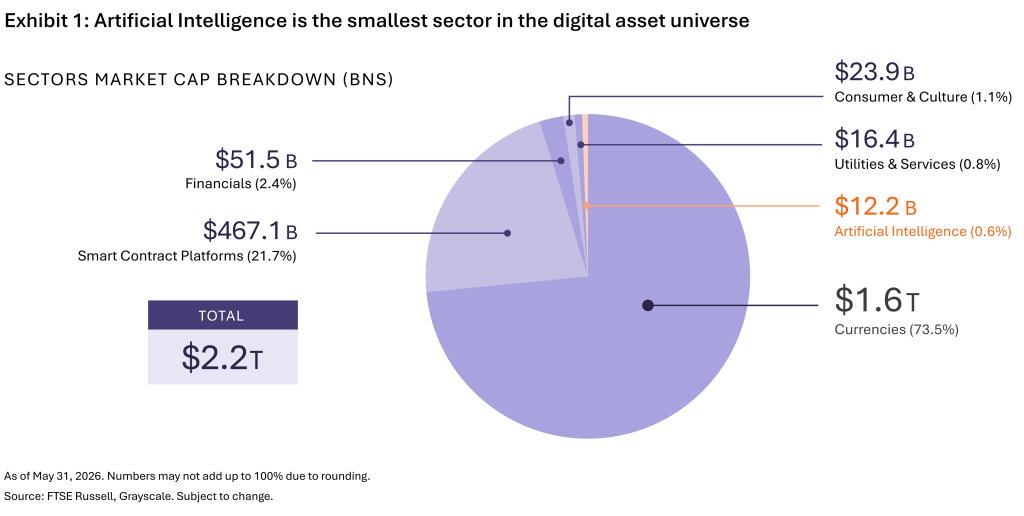
The Artificial Intelligence sector is relatively modest in size. As Exhibit 1 illustrates, the sector is the smallest sector in digital assets by market cap—just 0.6% of the value of all digital assets as measured by the Grayscale Crypto Sector Index—with 23 constituent tokens.1
In the following pages, we highlight three representative investable tokens in the sector: Bittensor, NEAR, and World.
Also, before we continue, a word on key terms and structure. As a companion to the Grayscale Institute’s Digital Asset Investing Fundamentals course, the knowledge in this primer series, like in the course, builds chronologically—this primer inherits knowledge from previous ones. In this light, please refer back to either previous classes (available on demand) or previous primers if you feel like you need a refresher at any time on certain topics, such as decentralized networks and applications, Proof of Work, Proof of Stake, and Layer 1 blockchains. All materials are available on the Grayscale Institute website.
III. Bittensor: A decentralized AI marketplace
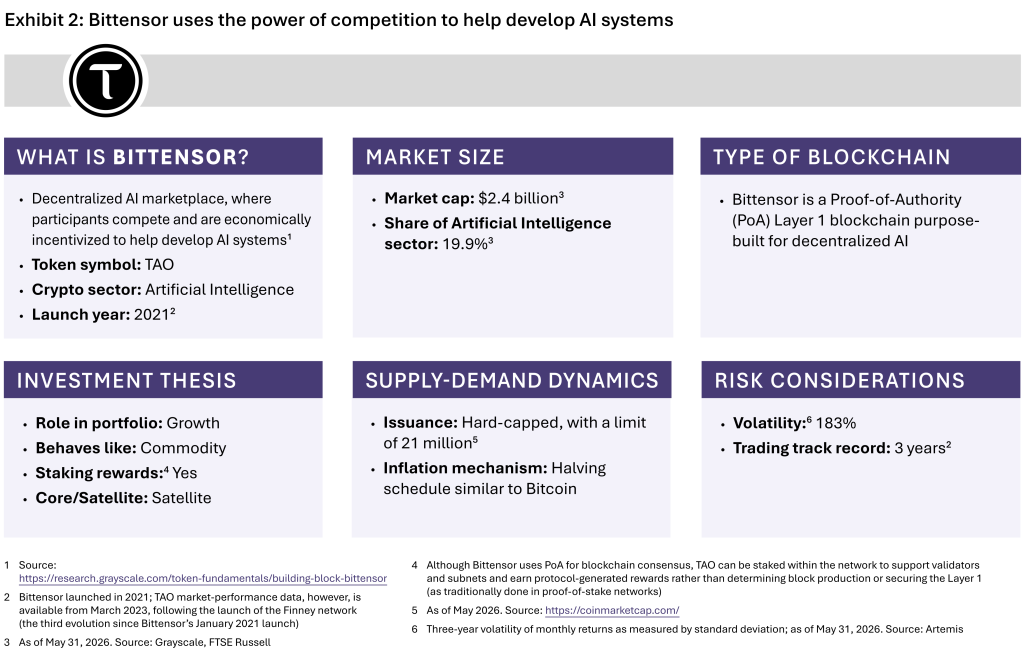
Bittensor is a decentralized AI marketplace where participants compete and are economically incentivized to help develop AI systems. It aims to create an “Internet of AI” with interconnected ecosystems called “subnets,” each focusing on a different specific use case. Developers compete to produce the best AI model outputs in exchange for rewards paid in the protocol’s native token, TAO.
Bittensor was launched in 2021. However, TAO market-performance data is only available from March 2023, following the launch of Finney, the third iteration of the network. TAO’s market capitalization was recently at $2.4 billion, accounting for 19.9% of Grayscale’s Artificial Intelligence sector index.
Bittensor is a Layer 1 blockchain purpose-built for decentralized AI. It uses Proof of Authority, or PoA, as its blockchain consensus mechanism. While not technically a proof-of-stake network, TAO tokens can be staked within the network to support validators and subnets and earn protocol-generated rewards. This differs from the role in a proof-of-stake blockchain that produces transaction blocks and secures the Layer 1 blockchain.
Currently, Bittensor has 128 subnets, spanning a range of applications and use cases, including video and image generation, AI agents, inference, data, deepfake detection, model training, and other AI services. As such, it provides a decentralized alternative to centralized AI incumbents such as OpenAI, Google, Anthropic, and other hyperscalers.
There are a number of ways in which Bittensor offers alternatives to centralized AI.
First, it better aligns economic incentives. Centralized AI companies prioritize shareholder value and profit, often resulting in value extraction from users. In contrast, by using its TAO token, Bittensor aligns incentives among ecosystem participants, including its users and tokenholders.
Second, Bittensor allows permissionless access to build and use AI. This contrasts to many centralized AI platforms, which often have high barriers to entry for developers.
Lastly, it creates a better way for open-source monetization. While open-weight AI models like DeepSeek’s R1 and Meta’s Llama offer benefits, open AI still largely struggles with monetization and coordination. Bittensor helps address this issue through TAO token emissions, allowing AI developers to monetize and fund their work.
From an allocation perspective, we consider Bittensor a growth asset playing a satellite role in digital asset portfolios.
IV. NEAR: A blockchain tailored to AI use cases
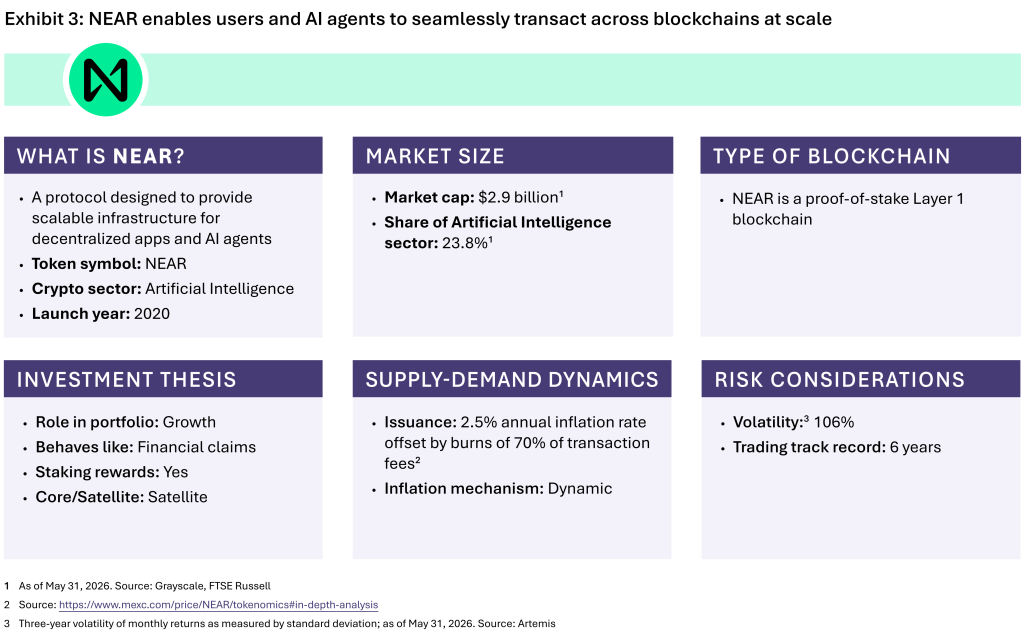
NEAR is a protocol designed to provide scalable infrastructure for decentralized apps and AI agents. The NEAR token launched in 2020, and its market capitalization was recently $2.9 billion, accounting for 23.8% of Grayscale’s Artificial Intelligence sector index.
NEAR is a Layer 1, proof-of-stake blockchain. Although built as a general-purpose blockchain, NEAR has increasingly optimized and positioned its ecosystem around AI functions, such as agents and user-owned AI. While developers can still build general-purpose decentralized apps on NEAR, the network’s focus is squarely on AI and agentic applications.
NEAR was founded by Illia Polosukhin, a leading figure in the AI industry and co-author of the “Attention Is All You Need” paper. That seminal paper introduced the so-called “Transformer” architecture, which allows AI models to understand relationships among words using “attention” rather than processing language sequentially. This has become the foundation of many modern large language models, including OpenAI’s ChatGPT.
As a high-performance, low-cost blockchain, NEAR leverages specific features to simplify blockchain complexities and enable users and AI agents to seamlessly transact assets across chains at scale. Beyond its core blockchain, NEAR is developing an integrated AI stack that includes privacy-preserving AI agents and confidential compute infrastructure.
From an allocation perspective, we consider NEAR a growth asset playing a satellite role in digital asset portfolios.
V. World: Pursuing Proof of Personhood
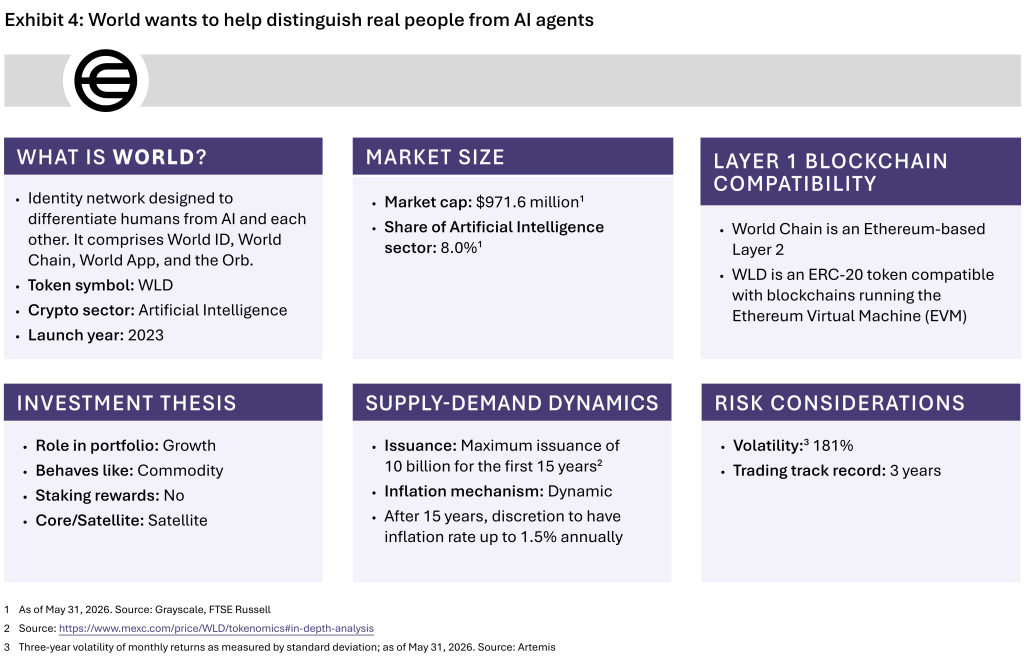
World offers identity services designed to differentiate humans from AI. World is an Ethereum Layer 2 network comprising a few elements that work together: World ID for proof of humanity, World Chain for blockchain transactions, World App for consumer access, and the Orb for human verification.
Sam Altman, CEO of OpenAI, is a co-founder of World. That makes sense. As OpenAI develops increasingly complex artificial intelligence models, the probability increases that AI agents will become more difficult to distinguish from human beings. In addition, it is important for individual humans to have a unique and verifiable identity, with a limit of one identity per person. In this context, World seeks to build a digital identity infrastructure layer spanning authentication, fraud prevention, and AI agent verification.
It is, in essence, an identity service based on “Proof of Personhood,” a type of verification system that takes on the challenge of distinguishing humans from AI agents and from each other. How does it do it?
It starts with the Orb, an imaging device that uses cameras and sensors to scan users’ irises and create a record of this unique biometric data. Once scanned and verified, World then creates the user a “World ID,” which is a privacy-preserving, unique digital identity that verifies humanness without revealing personal information.
Over 300 mini apps and ecosystem partners leverage World ID, including integrations with Zoom, Tinder, and Shopify, creating the potential for strong network effects. OpenAI is reportedly exploring a social network that could leverage World ID for proof of personhood and bot resistance.
From an allocation perspective, we consider World a growth asset playing a satellite role in digital asset portfolios.
VI. From mining to compute: How crypto infrastructure is ready to power the advance of AI
Over the last 10 years, Bitcoin miners continually increased the computing power used to secure the Bitcoin blockchain and process transactions. They scoured the world for the lowest-cost electricity and built massive data centers to hold millions of mining rigs. This was a profitable business as Bitcoin’s price rose from $680 in July 2016 to over $126,000 in October 2025.
Over the same time period, however, the block reward paid to miners every 10 minutes was halved twice. The block reward was 12.5 BTC in the four years through May 2020, when it fell to 6.25. It halved again in April 2024 to 3.125. So, while Bitcoin’s price increased 185 times from the 2016 halving to its peak in October 2025, the dollar value of the block reward paid to miners increased by only 46 times, or one-quarter of the dollar value of Bitcoin’s price increase.
Because the Bitcoin mining algorithm is calibrated to produce one block reward on average every 10 minutes, the cryptographic problem is adjusted to a higher difficulty as more computing power is added to the network. This means that a miner that increased its hash rate by four times may find that it is earning a similar number of block rewards, because its share of the global hash rate capacity may have remained unchanged, as all miners have been simultaneously making similarly large capital expenditures. These dynamics have created challenges for the mining industry, especially as Bitcoin prices have fallen to roughly $75,000 as of this report, and miners anticipate the next halving around April 2028.
The industry has been quick to adapt. In a December 2025 story, Wired Magazine proclaimed that “America’s Biggest Bitcoin Miners Are Pivoting to AI.” It appears that it is now more profitable to lease data center capacity to AI companies than to use it to mine Bitcoin. The data centers controlled by Bitcoin miners have become increasingly valuable, as the backlog for new electrical connections and the increasingly difficult political environment for obtaining permits to build new data centers mean that AI companies may have to wait years to build new capacity. For example, wait times may reach eight years for new projects in Virginia’s data center hub to be connected to the grid.2
As a result, millions of mining rigs are being moved out of data centers controlled by Bitcoin mining companies. They are being replaced by the AI compute powered by AMD and Nvidia chips and are owned or leased by neoclouds or hyperscalers. The majority of publicly-traded Bitcoin mining companies have announced pivots to AI, cloud computing, and high-performance computing in just the last six months. The need for AI compute seems destined to far outstrip that of Bitcoin mining, and those companies that are best positioned to meet that demand stand to benefit, in our view.
VII. How to access the tokens in the Artificial Intelligence sector
There are two primary ways to access digital assets across all sectors: direct ownership and ownership through commingled vehicles.3
Direct ownership means opening an account at a centralized exchange, completing know-your-customer verification, depositing fiat currency, and purchasing the asset. From there, an investor can leave holdings on the exchange or move to self-custody in a personal digital wallet. Commingled vehicles such as exchange-traded products (ETPs), exchange-traded funds (ETFs), and private funds offer exposure through structures investors already know and can be held in existing brokerage or retirement accounts.
Choosing between the two options comes down to a trade-off between control and convenience. We believe that for most investors seeking a diversified portfolio of digital assets, commingled vehicles, particularly ETPs and ETFs, offer the simplest and most operationally efficient way to gain exposure to digital assets, which helps explain the accelerating pace of institutional adoption we have seen recently.
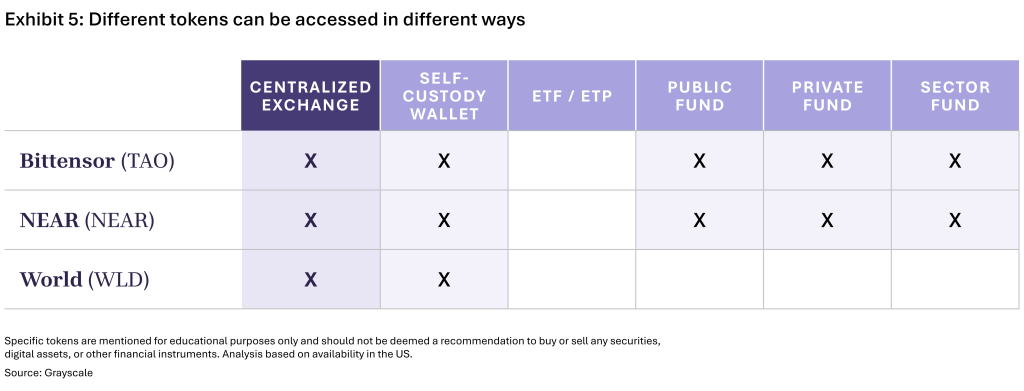
Exhibit 5 details investable vehicle availability for each of the tokens covered in this primer.
1 – As of May 31, 2026. Source: FTSE Russell, Grayscale. See https://www.grayscale.com/crypto-sectors
2 – Source: https://www.shovels.ai/blog/data-center-permits-decisions/
3 – For a detailed explanation, please refer to either the first class of the Digital Asset Investing Fundamentals Course or the first primer of this series. Both are available at https://grayscaleinstitute.com/
Important Information
Investments in digital assets are speculative investments that involve significant risk, including a partial or total loss of invested funds. Investments in digital assets are not suitable for any investor that cannot afford loss of the entire investment.
This material is not intended to be relied upon as a forecast, research, or investment advice, and is not a recommendation, offer or solicitation to buy or sell any securities or to adopt any investment strategy. The opinions expressed may change as subsequent conditions vary. The information and opinions contained in this material are derived from proprietary and nonproprietary sources deemed by Grayscale to be reliable, are not necessarily all-inclusive and are not guaranteed as to accuracy. Past performance is no guarantee of future results. There is no guarantee that any forecasts made will come to pass. Reliance upon information in this material is at the sole discretion of the reader.
You are solely responsible for evaluating and acting upon the education and information contained in this material. Grayscale will not be liable for direct or incidental loss resulting from applying any of the information obtained from these materials or from any other source mentioned. Grayscale does not render any legal, tax or accounting advice and the education and information contained in this material should not be construed as such. Please consult with a qualified professional for these types of advice. Grayscale and its employees may hold certain of the digital assets mentioned herein.
All content is original and has been researched and produced by Grayscale Investments Sponsors, LLC (“Grayscale”) unless otherwise stated herein. No part of this content may be reproduced in any form, or referred to in any other publication, without the express consent of Grayscale.
© 2026 Grayscale. All trademarks, service marks, and/or trade names (e.g., G™, GRAYSCALE®, GRAYSCALE CRYPTO SECTORS™, and GRAYSCALE INVESTMENTS®) are owned and/or registered by Grayscale.