
Key Takeaways
- Smart contract platforms are blockchains that function as “operating systems” for smart contracts—the second-largest crypto sector.
- Their tokens can earn substantial fees, so they’re valued mostly as financial claims and can pay staking yield.
- A common misperception is that crypto assets have no fundamental value. In fact, Grayscale Research finds that fee revenue correlates more closely with the market cap of smart contract platforms than other fundamentals—value accrues through network usage.
I. What are smart contract platforms?
Smart contract platforms are programmable blockchains. They function as “operating systems” on which open-source programs—known as “smart contracts”—can be built and whose output can be stored. Ethereum launched in 2015 as the first notable smart contract platform, laying the foundation for an ecosystem of decentralized applications.
These decentralized applications—traditionally built by third-party developers—run smart contract programs that can perform many tasks and enable a variety of onchain decentralized finance (DeFi) business models, such as borrowing, lending, and trading (all outside of the traditional banking or brokerage industries). Decentralized apps can also perform tasks and offer services beyond finance, such as peer-to-peer data storage and blockchain interoperability.
Every transaction or operation on these networks is paid for with the platform’s native token (think of the native token as the gasoline powering the platform’s engine), so the network captures value from all user activity, including transaction activity, user fees, and total value locked (TVL). Additionally, decentralized applications built on top of smart contract platforms can have their own non-platform-native tokens. These tokens are investable as well, and we will cover many of them in subsequent primers in this series.
In the remainder of this primer, we will first dimension this important digital asset sector. Using a consistent template, we will then profile several representative investable tokens— highlighting their market size, investment thesis, and risk considerations—so you can learn and compare them side by side.
II. Sizing the sector
The first step in understanding crypto sectors is to dimension them. Exhibit 1 shows that smart contract platforms are the second-largest crypto sector—about 21.7% of total digital- asset market cap. Our index encompasses 41 smart contract platforms (compared, for example, to 13 tokens in the Digital Currencies sector). The sector is large because it encompasses the networks that function as the “operating system”—known as Layer 1 networks—powering a vast range of digital assets.1
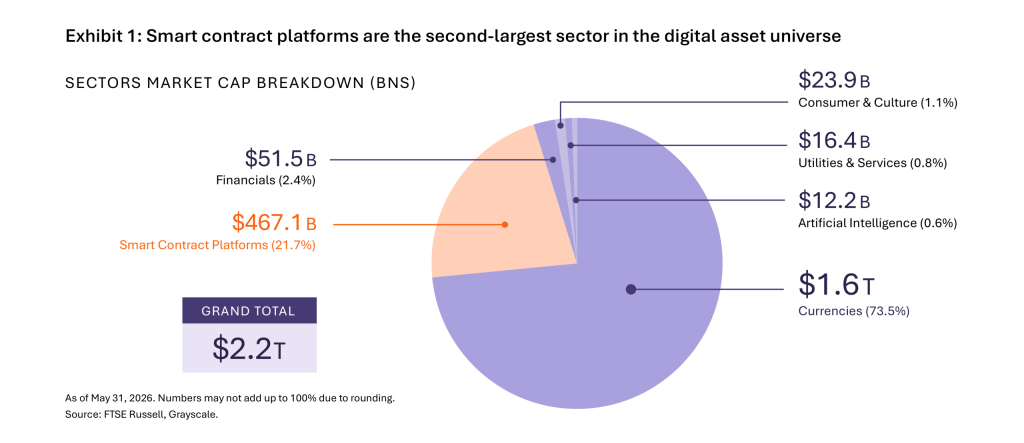
The Smart Contract Platform sector is home to many popular assets in the digital asset world. In this primer, we highlight a group of representative investable tokens: Ethereum (ETH), Avalanche (AVAX), Solana (SOL), BNB Chain (BNB), and Sui (SUI).
Also, before we continue, a word on key terms and structure. As a companion to the Grayscale Institute’s Digital Asset Investing Fundamentals course, the knowledge in this primer series, like in the course, builds chronologically—this primer inherits knowledge from the previous one, and so on. In this light, please refer back to either previous classes (available on demand) or previous primers if you feel like you need a refresher at any time on certain topics, such as proof-of-work and proof-of-stake blockchains, the role of miners and validators, our asset valuation approach by behavior (commodity or financial claims), among others. All materials are available on the Grayscale Institute website.
III. Ethereum: The first smart contract blockchain
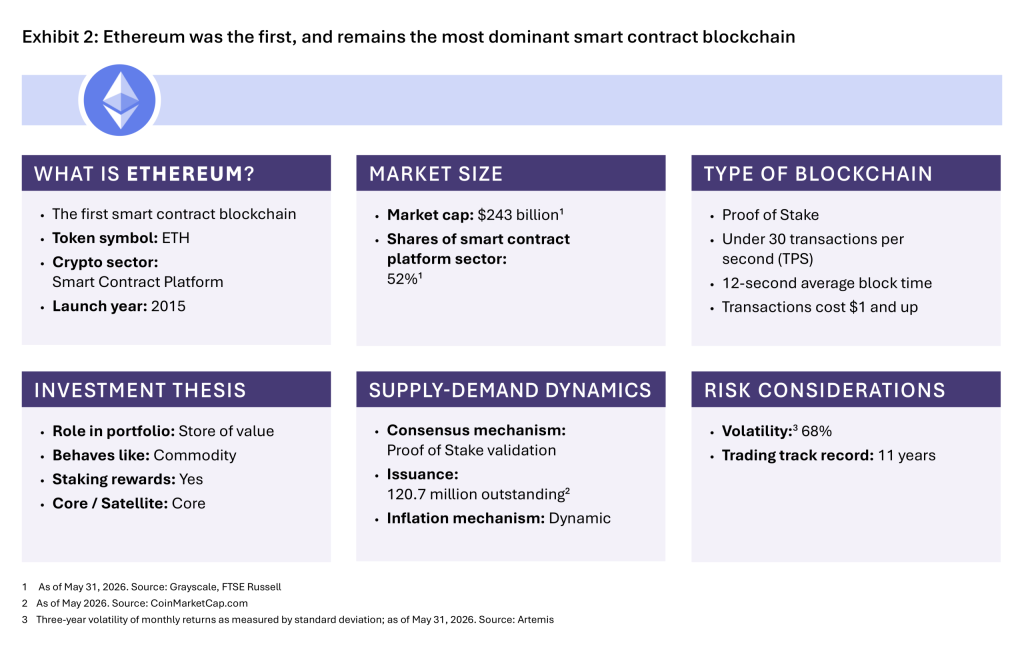
Ethereum launched in 2015, giving it an 11-year track record, and its native token, Ether, trades under ETH. As of May 2026, its market cap was roughly $243 billion, about 52% of Grayscale’s smart contract platform sector. Ether operates like a cryptocurrency and is used to pay for computation, incentivize validators, and serve as collateral.
Unlike digital currencies, Ethereum runs on a Proof-of-Stake blockchain: Validators are chosen to write blocks based on the size of their stake (e.g., a validator with 1% of staked Ether writes approximately 1% of blocks), earning rewards paid in kind (i.e., in Ether).
How value accrues: The key is usage. As more applications are created and grow more popular, network usage and the fees paid to validators rise—a virtuous circle. Validators earn staking rewards, priority fees, and maximum extractable value (MEV). Users pay “gas” fees based on a program’s complexity and network congestion; during congestion, a portion of the ETH paid is burned and retired from supply. Because issued tokens (funding staking yield) are offset by burned tokens, ETH supply is variable (i.e., net ETH issuance is “issuance minus burn”: When network activity is high, burning can exceed new issuance and the supply of Ether can shrink; when activity is low, the supply can grow). Priority fees resemble dividends; burned base fees resemble buybacks.
The Ethereum blockchain provides the network and is supplemented by the Ethereum Virtual Machine (EVM), the environment where smart contracts are executed. (Think of the EVM as the engine that runs the smart contracts and the blockchain as the place where the output of those transactions is secured and written.) Ethereum’s Layer 1 is relatively slow, handling about 7 to 15 transactions per second. As a result, much activity is delegated to Layer 2 networks—the function of which is to speed up transaction settlement and to lower costs. L2 networks—such as Base, Optimism, and Arbitrum—execute EVM-compatible transactions cheaply (often under 2 cents versus $1+ on L1) and settle results back to the secure, decentralized Layer 1.
From an allocation perspective, given its size, track record, and widespread ownership, we consider ETH a core asset in a digital asset portfolio.
IV. Avalanche: Scale and customization
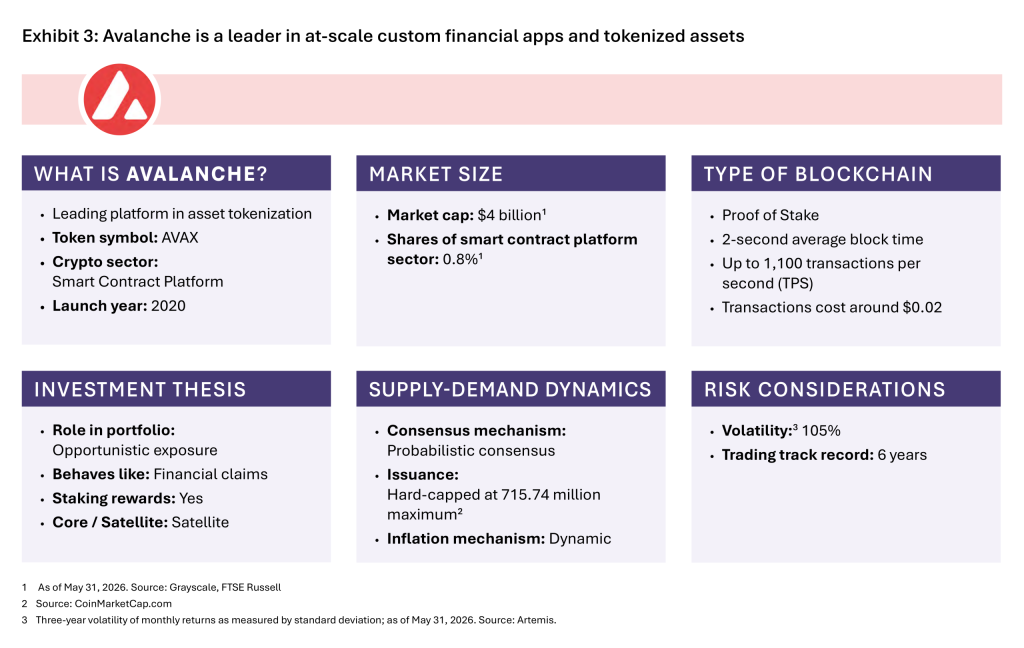
Avalanche launched in 2020, giving it a 6-year track record, and its token trades as AVAX. As of May 2026, its market cap was $4 billion, about 0.8% of the sector. Like Ethereum, it runs on Proof of Stake, with a two-second average block time and up to 1,100 transactions per second.
Avalanche is best perceived as a network of Layer 1 blockchains. It is built to address the “blockchain trilemma”—scalability, decentralization, and security— through a three-chain architecture: the X-Chain (creating and transferring assets), the C-Chain (Ethereum-compatible smart contracts), and the P-Chain (validator coordination and creating custom Avalanche L1s). Its differentiator is mass customization: Avalanche L1s are application-specific blockchains tailored to different regulatory, geographic, or technical requirements, letting enterprises build their own chains without affecting the broader network.
This flexibility has driven real-world adoption—gaming titles, asset managers such as KKR and Apollo tokenizing funds, public-sector projects digitizing property and vehicle-title records, and sports and entertainment partnerships. AVAX is used for fees, staking, securing the network, and governance.
From an allocation perspective, we consider AVAX a satellite holding in a digital asset portfolio, in part due to its still relatively small market capitalization.
V. Solana: Crypto’s financial bazaar
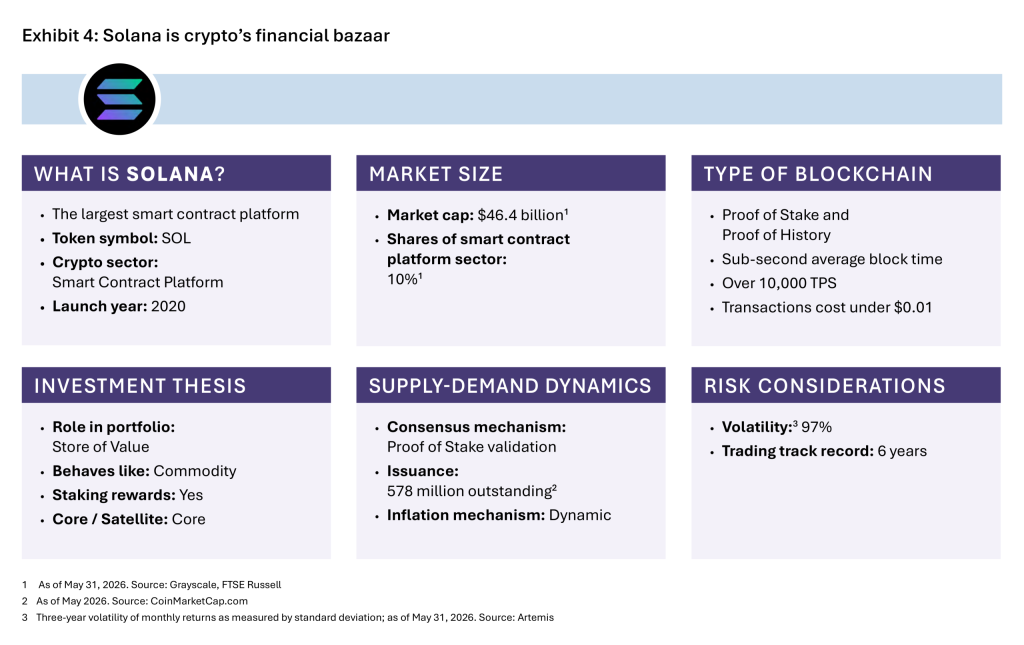
Solana is the largest smart contract platform by transaction volume. It launched in 2020, giving it a 6-year track record, and its native token trades as SOL. As of May 2026, its market cap was roughly $46.4 billion, about 10% of the sector. It runs on a Proof-of-Stake blockchain optimized for performance—extraordinarily cheap and fast.
Today Solana is the category leader in users, transaction volume, and transaction fees. It hosts industry-leading applications across DeFi, consumer and social apps, and physical infrastructure (DePIN), and offers one of the best new-user experiences in crypto. The network produces new blocks every 400 milliseconds with finality in about 12 to 13 seconds,2 and year-to-date median daily fees have averaged about one-tenth of one cent, helped by local fee markets that limit fee competition to specific in-demand apps.
Solana also pursues a distinct technical strategy: It uses the proprietary Solana Virtual Machine (SVM), which is not compatible with the Ethereum Virtual Machine. SVM applications can’t easily be ported to non-SVM chains, potentially contributing to sticky demand. More than 1,000 full-time developers work on Solana, and that community is growing faster than on other platforms.
From an allocation perspective, we consider SOL a core holding in a digital asset portfolio given its size, leadership, and developer community.
VI. BNB Chain: A high-throughput ecosystem
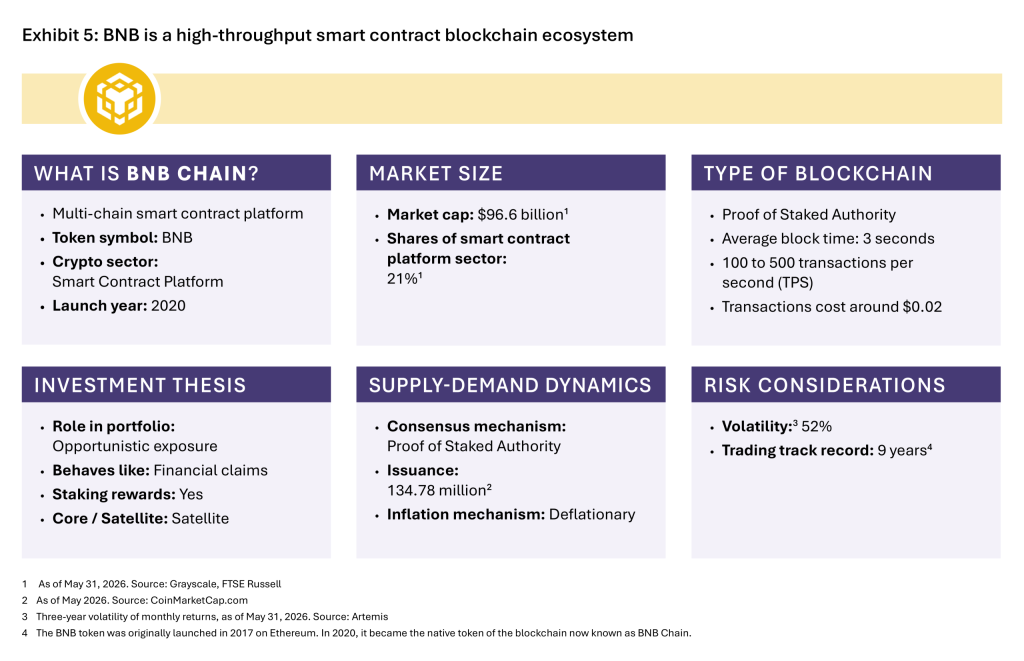
BNB Chain is a high-throughput smart contract ecosystem built for mass-market applications. It was originally launched by Binance as Binance Smart Chain in 2020 and rebranded in 2022. Its native token—which was originally launched in 2017 on Ethereum and became the token of the blockchain now known as BNB Chain in 2020—has a nine-year track record and trades as BNB. As of May 2026, its market cap was roughly $96.6 billion, or 21% of the sector—the second- largest platform by market cap (after Ethereum) and third by TVL. It runs on a Proof of Staked Authority network with three- second blocks and up to 500 transactions per second, typically costing around two cents.
BNB has a deflationary tokenomics model: The maximum supply has already been reached, and the circulating number regularly declines through token burning, with an initial supply of 200 million targeted to fall to a floor of 100 million. The ecosystem has three interoperable parts—the BNB Smart Chain (an EVM-compatible Layer 1), opBNB (a Layer 2 rollup on the Optimism OP Stack), and BNB Greenfield (decentralized storage). Its Proof of Staked Authority uses 21 validators elected from a larger pool, enabling millions of transactions per day.
Combined with Binance’s distribution, this has made BNB Chain a leading network for retail DeFi, stablecoin payments, gaming, and tokenization.
From an allocation perspective, we consider BNB a satellite holding in a digital asset portfolio.
VII. Sui: The usability platform
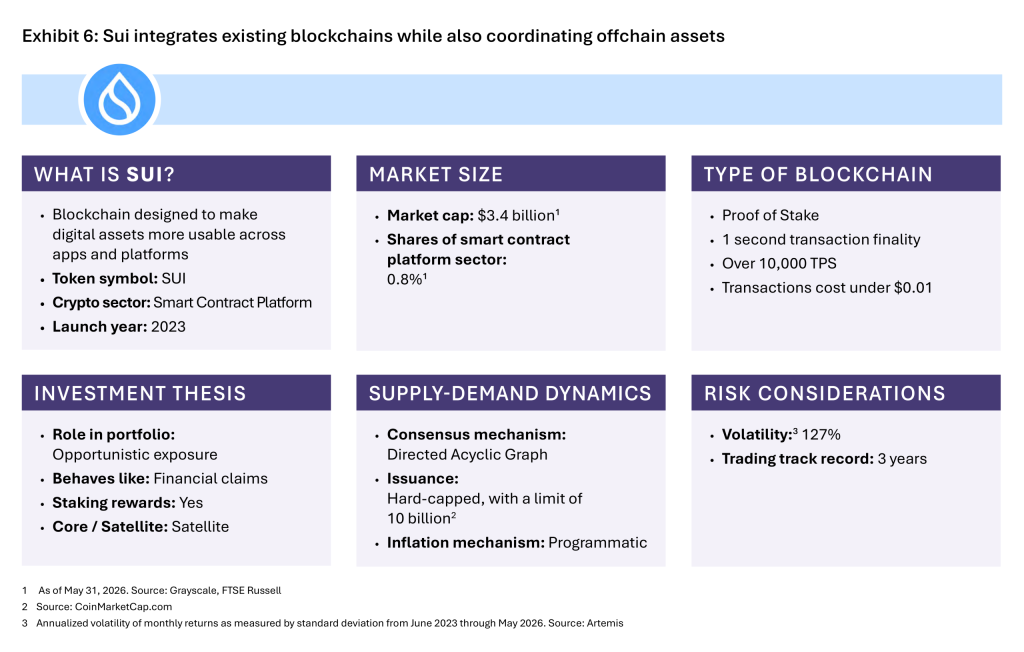
Founded by key members of Facebook’s Diem project, Sui is known for ease of integration with existing blockchains and coordinating off-chain assets. It launched in 2023, giving it a 3-year track record, and its native token trades as SUI. As of May 2026, its market cap was roughly $3.4 billion, about 0.8% of the sector. Like Ethereum and Avalanche, it runs on Proof of Stake; like Solana it is extraordinarily fast and cheap, with one-second finality and over 10,000 transactions per second. Supply is capped at 10 billion (roughly four billion outstanding, with more than half expected after 2030).
Sui prioritizes usability and scalability, aiming to exceed even the best Web 2.0 experiences—offering sub-second speeds, private on-chain data storage, password recovery, and peer- to-peer transactions without an internet connection. It is positioned as a global coordination layer, letting users control assets across blockchains and offchain infrastructure from Sui, and its capacity grows with computational power as validators add servers. As a result, Sui offers the highest theoretical throughput, lowest cost, and fastest finality among the five largest platforms.
From an allocation perspective, we consider SUI a satellite, opportunistic holding in a digital asset portfolio.
VIII. How to access the tokens in the Smart Contract Platforms sector
There are two primary ways to access digital assets across all sectors: direct ownership and ownership through commingled vehicles.3
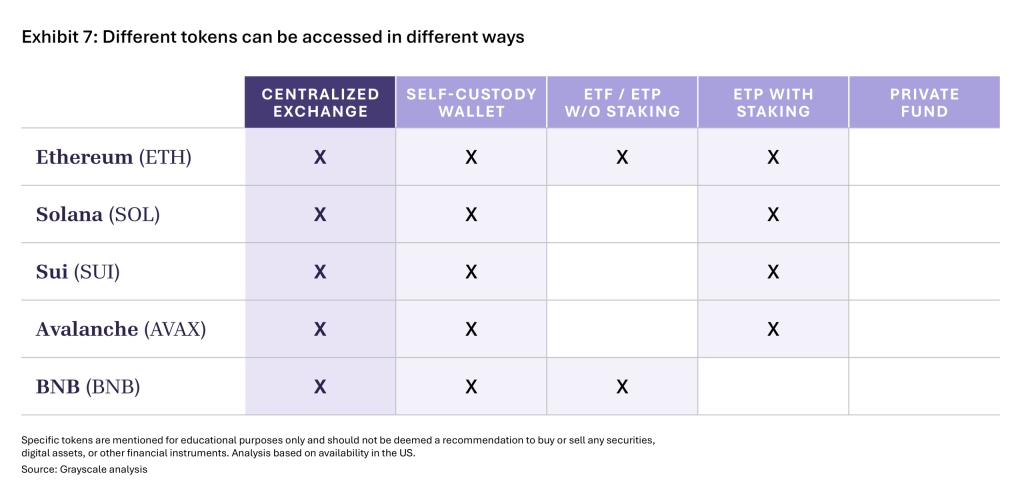
Direct ownership means opening an account at a centralized exchange, completing know-your-customer verification, depositing fiat currency, and purchasing the asset. From there, an investor can leave holdings on the exchange or move to self-custody in a personal digital wallet. Commingled vehicles such as exchange-traded products (ETPs), exchange-traded funds (ETFs), and private funds offer exposure through structures investors already know and can be held in existing brokerage or retirement accounts.
Choosing between the two options comes down to a trade- off between control and convenience. We believe that for most investors seeking a diversified portfolio of digital assets, commingled vehicles, particularly ETPs and ETFs, offer the simplest and most operationally efficient way to gain exposure to digital assets, which helps explain the accelerating pace of institutional adoption we have seen recently.
Exhibit 7 details investable vehicle availability for each of the tokens covered in this primer.
1 – As of May 31, 2026. Source: FTSE Russell, Grayscale. https://www.grayscale.com/crypto-sectors
2 – https://chainspect.app/chain/solana
3 – For a detailed explanation, please refer to either the first class of the Digital Asset Investing Fundamentals Course or the first primer of this series. Both are available at https://grayscaleinstitute.com/
Important Information
Investments in digital assets are speculative investments that involve significant risk, including a partial or total loss of invested funds. Investments in digital assets are not suitable for any investor that cannot afford loss of the entire investment.
This material is not intended to be relied upon as a forecast, research, or investment advice, and is not a recommendation, offer or solicitation to buy or sell any securities or to adopt any investment strategy. The opinions expressed may change as subsequent conditions vary. The information and opinions contained in this material are derived from proprietary and nonproprietary sources deemed by Grayscale to be reliable, are not necessarily all-inclusive and are not guaranteed as to accuracy. Past performance is no guarantee of future results. There is no guarantee that any forecasts made will come to pass. Reliance upon information in this material is at the sole discretion of the reader.
You are solely responsible for evaluating and acting upon the education and information contained in this material. Grayscale will not be liable for direct or incidental loss resulting from applying any of the information obtained from these materials or from any other source mentioned. Grayscale does not render any legal, tax or accounting advice and the education and information contained in this material should not be construed as such. Please consult with a qualified professional for these types of advice. Grayscale and its employees may hold certain of the digital assets mentioned herein.
All content is original and has been researched and produced by Grayscale Investments Sponsors, LLC (“Grayscale”) unless otherwise stated herein. No part of this content may be reproduced in any form, or referred to in any other publication, without the express consent of Grayscale.
© 2026 Grayscale. All trademarks, service marks, and/or trade names (e.g., G™, GRAYSCALE®, GRAYSCALE CRYPTO SECTORS™, and GRAYSCALE INVESTMENTS®) are owned and/or registered by Grayscale.Content goes here!