
Key Takeaways
- Digital assets are those assets whose ownership is tracked on a blockchain.
- Blockchain is a cryptographically secured distributed ledger.
- Blockchains are traditionally operated on a proof of work or a proof of stake basis, which establishes how assets are created, and how the network functions and is secured.
- In terms of valuation, we see assets split in two broad groups: Those that behave more like commodities and those that behave more like financial claims, similar to a stock or a bond. Through that lens, valuation of digital assets follows, for the most part, similar principles and methodology used to value traditional assets.
- Investors can access digital assets through direct ownership or commingled vehicles.
I. What are digital assets?
We define digital assets as any asset whose ownership is tracked on a blockchain—a cryptographically secured distributed ledger (more details on these terms later). That single definition covers a surprisingly wide range of instruments, which are generally grouped into four categories:
- Crypto assets: Native blockchain assets, such as Bitcoin and Ethereum.
- Tokenized assets: Digital ownership records of real-world assets such as gold, stocks, funds, or real estate.
- Stablecoins: Assets designed to hold a stable value by being backed one-for-one by currencies, such as the US Dollar or the Euro.
- Non-fungible tokens (NFTs): Ownership of unique digital items, such as art, music, or video game accessories.
This primer will concentrate on crypto assets because they set the foundation for understanding the asset class as a whole. We will first introduce the concept of decentralized ledgers and show how ownership of crypto assets is established. Then—using Bitcoin and Ethereum as examples—we will explain key terms widely associated with digital assets, such as blockchain, Proof of Work, and Proof of Stake. We then turn our attention to how these assets are valued and how to invest in them.
II. How do digital assets work?
Ledgers and Ownership
To understand how digital assets work, we must start with the ledger.
First, an overview of the predominant system used in traditional finance today: the centralized ledger. Most of us have bank and brokerage accounts. Every transaction— deposits, withdrawals, trades—that takes place in those accounts is recorded on a centralized ledger controlled by a single institution: one bank, one brokerage firm, one ledger.
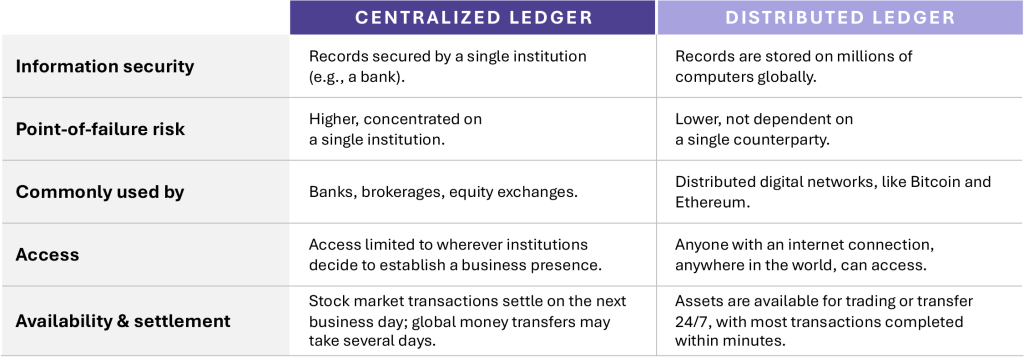
Centralized ledgers concentrate risk on a single point of failure. Whether it is a cybersecurity breach, an institutional failure, or a cloud outage, any or all of the above can compromise access to an investor’s assets. Access is also limited to wherever the institution has chosen to establish a business presence, and investors are subject to the financial regulations of that host country. Further, settlement tends to be relatively slow: US stock trades settle one business day after the trade, and international wire transfers can take several days to clear. There are few instantaneous transactions in the world of traditional finance.
Enter a new concept: the distributed ledger. Rather than being stored by a single bank or brokerage firm, records of transactions, balances, and ownership on a distributed ledger are maintained on millions of computers spread across dozens of countries. That eliminates the risk of a single point of failure. What’s more, most transactions are completed within minutes, if not seconds. Exhibit 1 details the key differences between these two approaches to record keeping.
Exhibit 1: Distributed ledgers offer several improvements over centralized ones
Asset ownership on a distributed ledger is established through cryptography—which is where the name “crypto” comes from. On a distributed ledger, most transactions are transparent to the world, but the ability to transact in those assets is secured through the use of cryptographic keys. Exhibit 2 provides a detailed schematic of how this process works.
Exhibit 2: The combination of public and private keys establishes and helps protect ownership of digital assets
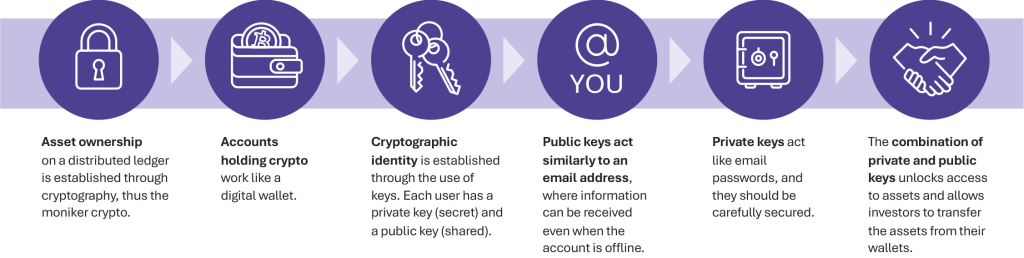
The key thing (no pun intended) to remember here is that cryptographic security is established through a combination of private and public keys, which interact to lock and unlock access and allow for transfers of assets among investors. Also: Unlike traditional finance, there is no password reset. Whoever controls the private key controls the asset—which is why protecting that key is one of the most important responsibilities of direct digital asset ownership. Lose it, and your assets could be lost forever.
At this stage, you might be wondering: Is a cryptographically maintained distributed ledger the same thing as a blockchain? Here’s the answer: All blockchains are distributed ledgers but not all distributed ledgers are blockchains. That said, that distinction matters little for the purposes of this paper because all investable digital assets we will cover in this primer—and subsequent ones—will be on blockchains.
Two of the most important types of blockchain are Proof of Work and Proof of Stake. We will use Bitcoin and Ethereum— the most widely known crypto assets—to help us understand each one of them.
Proof-of-Work (PoW) Blockchains
Bitcoin, the first and still the largest cryptocurrency1, runs on a proof-of-work blockchain.
The key trait of a proof-of-work blockchain is its miners. They are responsible for maintaining and securing the network as well as validating transactions. The miners also play a key role in the creation of new assets (i.e., how new Bitcoin are generated; more on that later).
Exhibit 3 provides a detailed schematic of how Bitcoin’s Proof of Work blockchain operates. The key thing to remember here is that as transactions are created (e.g., investor A sells Bitcoin to investor B), miners verify them and compete to solve a computationally intensive cryptographic puzzle (a.k.a., a proof-of-work puzzle) to earn the right to add a new block of transactions to the ledger (in the case of Bitcoin, a new block is added roughly every 10 minutes).
Exhibit 3: How proof-of-work mining process secures the network
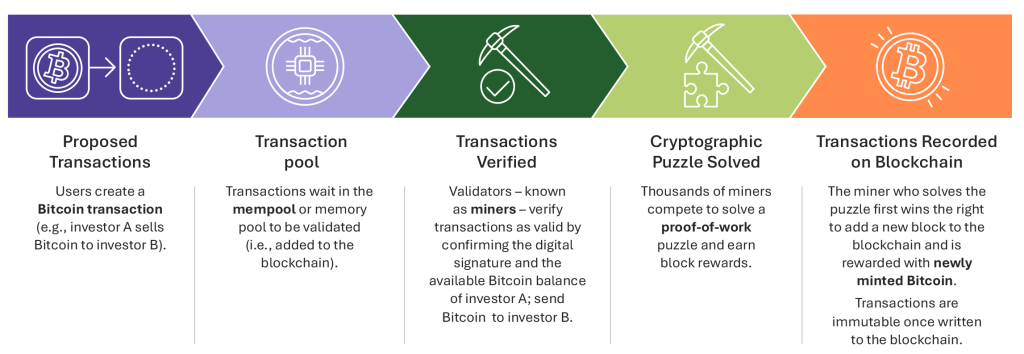
The winning miner is compensated with newly minted Bitcoin. As of this writing,2 miners received 3.125 BTC per block added, worth roughly $194,000. Once written, transactions are immutable and secured by cryptographic “hashing,” which links each block to the next (that’s where the name blockchain comes from). Any attempt to alter a past transaction breaks the chain and is immediately rejected by the network.
Although we used Bitcoin to exemplify what Proof of Work is, it is important to note that all other crypto assets that run on a PoW blockchain operate in a similar fashion, from the role of the miners to the genesis of new assets (we will cover those in subsequent papers in this series).
One other compelling attribute of Bitcoin (and of many other digital assets that run on PoW blockchains) is its fixed supply: There will only ever be 21 million Bitcoin. Roughly 20 million have been mined to date, and the cap will be reached in 2140—only 5% above today’s level. The block reward for miners halves roughly every four years, slowing the pace of new issuance on a schedule hard coded into the protocol. From January 2020 to June 2026, for example, the supply of Bitcoin grew by just 10.5%.3 Over the same period, the US Consumer Price Index (CPI) was up 29.5%.4 This scarcity is central to how investors think about Bitcoin’s value, which we cover in detail later in this primer.
Proof-of-Stake (PoS) Blockchains
The first thing to know about Proof-of-Stake blockchains is that these are decentralized platforms that allow developers to run programmable applications—known as smart contracts—on a global, shared network without a central authority. That’s a key difference from a PoW blockchain, most of which do not allow smart contracts. Let’s use Ethereum, the largest smart-contract platform in the world, to further explain this type of blockchain.
Think of Ethereum’s proof-of-stake blockchain as a computer operating system. It provides the infrastructure, and developers build applications on top of it. Each PoS blockchain has its own native asset that “powers” it. In the case of Ethereum, its native token is called Ether (ETH). It functions like a crypto asset, is used to pay for computation (commonly called “gas” fees), and serves as collateral for validators—Ethereum’s equivalent of Bitcoin miners.
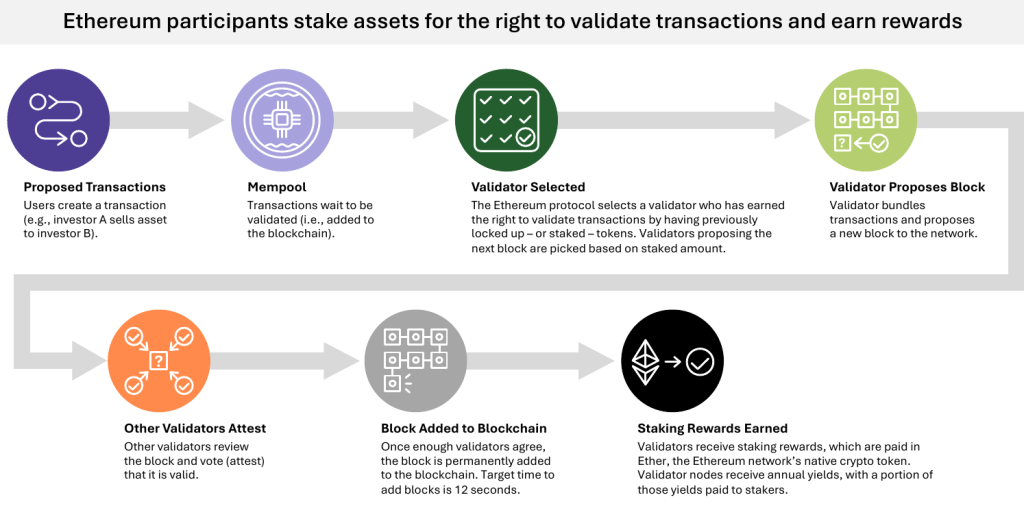
Exhibit 4 explains in detail how Ethereum’s proof-of-stake blockchain works. The key thing here is that rather than competing to solve a cryptographic puzzle, Ethereum validators are selected to process transactions based on the amount of Ether they have locked up, or “staked,” in the network (i.e., the more “skin in the game” they have, the higher the odds of being picked as a validator). Once selected, the validator is compensated by receiving a staking reward for their service, which is composed of newly minted Ether and certain types of transaction fees. It’s important to note that this staking/validation process is how new Ether is created (more on that later).
Exhibit 4: How Ethereum’s proof-of-stake blockchain works
Understanding Decentralized Finance (DeFi)
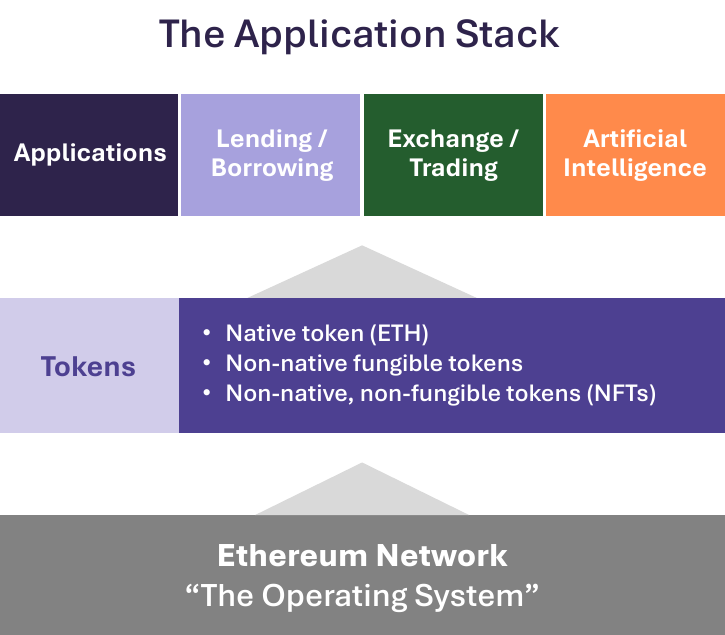
The key functionality that smart-contract platforms unlock is the ability for developers to build applications directly on top of the network—much like apps built on an operating system. These decentralized applications are at the heart of what has become known as decentralized finance, or DeFi.
These decentralized apps allow activities—such as lending, borrowing, and trading—to be conducted on- chain (i.e., on blockchain “rails”), entirely outside of traditional bank and brokerage channels. Exhibit 5 exemplifies what the resulting “application stack” looks like. The important thing to learn here is that applications built on these networks can issue their own tokens (which are investable instruments in and of themselves), provided they remain compatible with the underlying network.
Exhibit 5: Smart-contract platforms like Ethereum enable decentralized finance (DeFi)
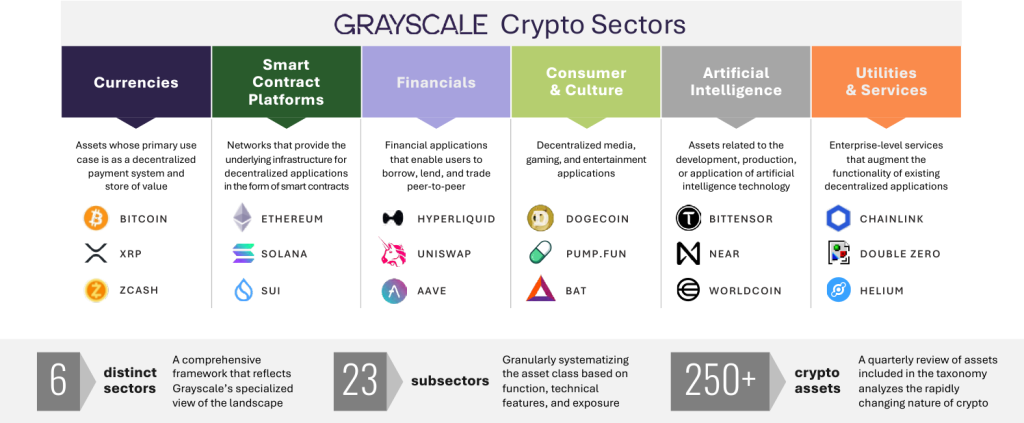
That resulting investable universe built on top of these platforms is vast. That’s why Grayscale, in partnership with FTSE Russell, has built a taxonomy that organizes more than 250 crypto assets across six sectors and twenty-three subsectors—spanning currencies, smart contract platforms, financials, artificial intelligence, consumer and culture, and utilities and services (Exhibit 6). We will cover many of these investable tokens in subsequent papers in this series.
Exhibit 6: A taxonomy to help map the digital asset investable universe
III. How to value digital assets?
Token Supply Mechanics
Just as a fiat currency loses value when a central bank runs the printing press indiscriminately, the value of a digital asset is closely tied to the amount of tokens in circulation. Before we can value digital assets, then, we need to understand how new tokens enter circulation. That mechanism depends entirely on whether a network uses proof of work or proof of stake.
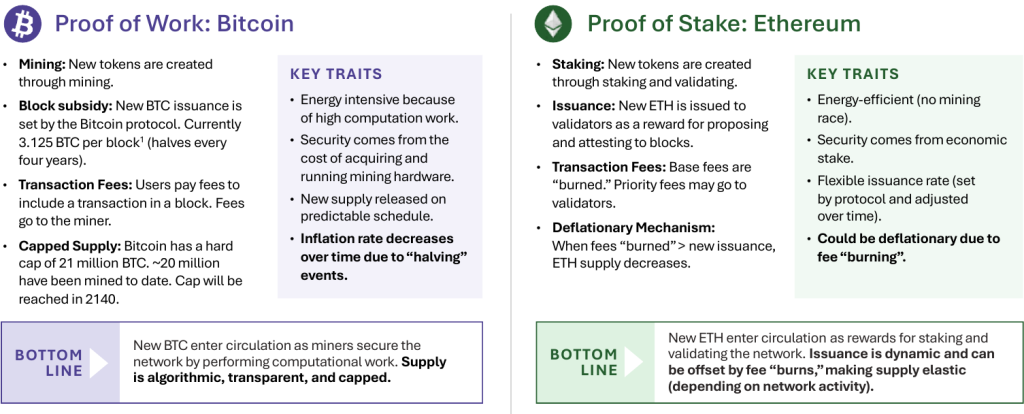
Proof-of-work models, the most prominent being Bitcoin, tie new supply directly to mining. New BTC, for example, enters circulation as miners secure the network by performing computational work: the current block subsidy is 3.125 BTC, a figure that halves roughly every four years. Bitcoin also carries a hard cap of 21 million tokens, of which roughly 20 million have already been mined. The combination of halving and a hard cap means Bitcoin’s inflation rate is designed to fall over time—a static, protocol-enforced monetary policy that is transparent and fully algorithmic.
Proof-of-stake models, such as Ethereum’s, work differently. New ETH is issued to validators as a reward for proposing and attesting to blocks, but a portion of transaction fees— so-called “base” fees—is “burned,” or permanently destroyed, rather than paid to anyone. Net Ether issuance is thus “issuance minus burn”: when network activity is high, burning can exceed new issuance and the supply of Ether can shrink; when activity is low, the supply can grow. Unlike Bitcoin’s programmatic schedule, Ethereum’s issuance is dynamic and elastic, tied directly to how much the network is actually being used.
The bottom line for both networks: On Proof-of-Work networks, the supply is typically algorithmic, transparent, and capped, while on Proof-of-Stake networks, the supply is usually dynamic and can be offset by fee burning, making it elastic and dependent on network activity (Exhibit 7). This distinction—fixed scarcity versus usage-linked elasticity—is the starting point for the valuation frameworks that follow.
Exhibit 7: The mechanics of token supply depend on the type of network
Valuation Frameworks
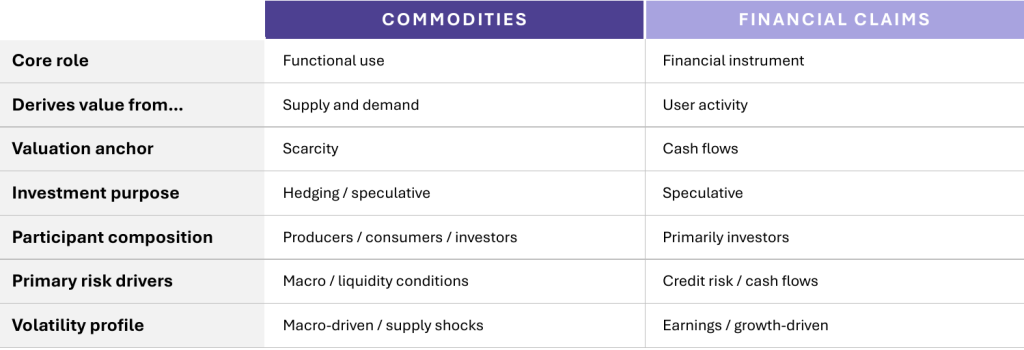
Not all digital assets behave the same way, so Grayscale splits the universe into two broad groups. On the one hand, there are assets like Bitcoin, Ethereum, and Solana that behave more like commodities. Their price is set primarily by supply and demand, and their value depends on scarcity and usefulness. On the other hand, there are assets like Aave, Chainlink, and Hyperliquid that behave more like financial claims, similar to a stock or a bond. Their price is a function of capital return to investors, and their value is ultimately anchored to cash flows rather than functional use.
For commodity-like assets, three factors matter the most: usage, scarcity, and supply and demand.
- Usage: the more participants a network has, the more valuable it becomes.
- Scarcity: A limited token supply avoids dilution and supports store-of-value characteristics.
- Supply & Demand: Since the January 2024 launch of spot Bitcoin ETPs, fund purchases of Bitcoin have outpaced new mining supply, a dynamic that tends to support price as demand grows against a fixed supply.
For financial-claims assets, the analysis looks more like traditional equity research. These decentralized applications are not businesses in a legal sense, but they can be analyzed similarly. Users pay fees that function as revenue, and that revenue can be discounted back to the present using a discounted cash flow approach. Token buybacks and staking yields are the crypto analogues of equity buybacks and dividends, respectively, and a platform’s fundamental activity—fee revenue, transaction volume, and total value locked—anchors its valuation.
Exhibit 8 summarizes the key conceptual differences between the two valuation approaches. The key takeaway is that although digital assets are a genuinely new category, the valuation logic applied to them is, in large part, borrowed from valuing traditional assets—commodities, stocks, and bonds. Investors do not need to abandon fundamental analysis when they enter this asset class. They simply need to know which fundamental framework applies to which token.
Exhibit 8: How you value a digital asset depends on how it behaves
IV. How to invest in digital assets?
Market Sizing and Diversification
Digital assets have grown from a standing start some 15 years ago to a mid-sized alternative asset class today. Bitcoin still accounts for the majority of the market capitalization of the category, though other digital assets have made inroads.5
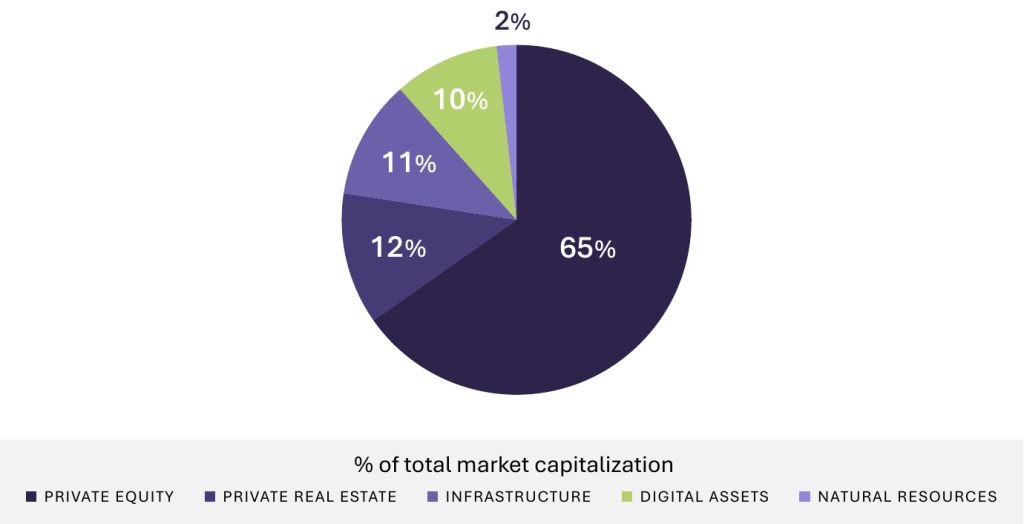
Sized against other alternative asset classes, digital assets represent roughly 10% of the combined market capitalization of all major alternative categories, including private equity, private real estate, infrastructure, and natural resources (Exhibit 9). With one significant advantage: They typically trade 24/7, with liquidity that can rival that of some publicly traded stocks and bonds. For an investor targeting a balanced alternatives sleeve, a starting allocation to digital assets of around 10% could be a reasonable point of entry. Investors with a zero exposure to digital assets are effectively actively underweighting a rapidly growing part of the alternatives universe.
Exhibit 9: Digital assets now represent a significant share of alternative assets
Correlation is the other side of the diversification story. Most crypto assets are volatile on a standalone basis, but the relevant question for a portfolio is not standalone volatility—it is the asset’s contribution to overall portfolio risk. Because digital assets have historically shown relatively low correlation to the S&P 5006 and other traditional asset classes, a modest allocation does not necessarily increase overall portfolio volatility, and it may even improve a diversified portfolio’s risk-return profile over time.
Two Ways to Access and Invest in Digital Assets
There are two primary ways to access digital assets: direct ownership and ownership through commingled vehicles.
Direct ownership means opening an account at a centralized exchange, such as Coinbase or Binance, completing know- your-customer verification, depositing fiat currency, and purchasing the asset. From there, an investor can leave holdings on the exchange or move to self-custody in a personal digital wallet, where ownership is written directly to the blockchain. The first option is convenient, but the assets are technically owned by the exchange, with the investor’s balance reflected only on the exchange’s internal ledger. The second option, self-custody, carries some additional risk: there is no password reset for a lost private key, and private keys have been permanently lost to fires, floods, and hard drive failures.
Commingled vehicles such as exchange-traded products (ETPs), exchange-traded funds (ETFs), and private funds offer exposure through structures investors already know and can be held in existing brokerage or retirement accounts. The market has embraced these vehicles quickly: Spot Bitcoin ETPs launched in January 2024, and by December 2025 these products held approximately $114 billion7 in assets, equal to about 7% of Bitcoin’s entire market capitalization at the time.8 Private funds offer a further option for investors prepared to accept reduced liquidity in return for access to strategies or tokens not yet available through an ETP or ETF.
Choosing between a digital wallet and a commingled vehicle comes down to a trade-off between control and convenience (Exhibit 10). With self-custody, an investor owns the underlying asset outright and holds the private keys directly, but bears full responsibility for safeguarding those keys, managing staking independently if desired, and handling potentially complex tax reporting.
Exhibit 10: There are significant differences between direct and commingled ownership
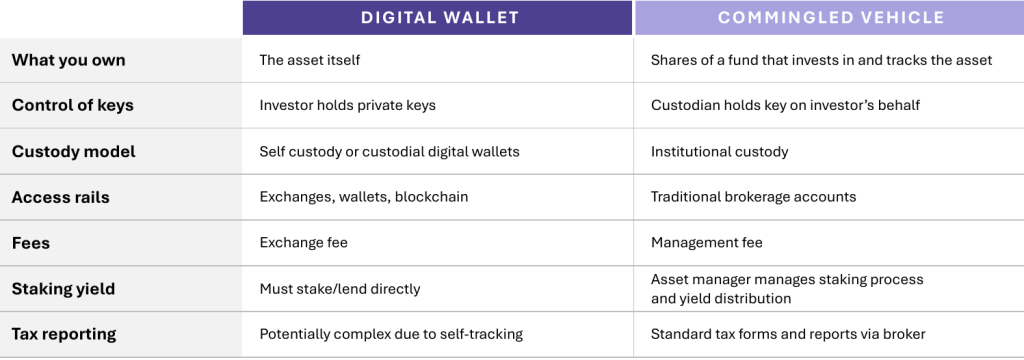
With a commingled vehicle, an intermediary holds the keys on the investor’s behalf within institutional custody, the asset is held in a familiar brokerage or retirement account, and tax reporting is simplified via standard broker forms.
Commingled vehicles also offer variety beyond simple spot exposures within a single institutional wrapper, including staking strategies that earn yield on proof-of-stake tokens such as Ether or Solana, multi-token strategies that combine several assets in one fund, covered-call strategies that sell options for yield, and, through certain private funds, even leverage or shorting strategies. Investors can also gain equity-style exposure to the industry itself through publicly traded Bitcoin miners or stablecoin issuers.
For most investors building a diversified portfolio, commingled vehicles, particularly ETPs and ETFs, offer the simplest and most operationally efficient way to gain exposure to digital assets, in our view, which helps explain the accelerating pace of institutional adoption we have seen recently.
Lastly, a few words on regulation. Regulation matters for digital assets for three reasons: the asset class is still young, different tokens behave differently (some like commodities, others like financial claims), and the space continues to evolve quickly with new business models and instruments.
That said, it is important to know that many of the rules that apply in the traditional finance world also apply to crypto assets. While the regulatory environment is still evolving, regulators worldwide already enforce anti-money-laundering (AML) and know-your-customer (KYC) requirements, which means that identity verification is required before an investor can move between fiat currency and crypto on a centralized exchange.
1 – Source: Bitcoin.org
2 – As of July 8, 2026
3 – Source: CoinMarketCap.com
4 – Source: CPIInflationCalculator.com
5 – Source: Preqin, Artemis, Grayscale Investments. Preqin alternatives AUM breakdown as of Q3 2025. Artemis total crypto market cap as of Q3 2025. For illustrative purposes only.
6 – Source: Bloomberg, Grayscale Investments. Correlation of monthly returns with S&P 500 calculated from Jan 2019 through February 2026. Results: Crypto Index based on FTSE/Grayscale Crypto Sectors Index (market cap-weighted) had correlation of .49, Bitcoin (Bloomberg price) had correlation of .43. That compares to much higher correlations such as .83 for International Stocks (MSCI All Country Ex-US Index), .77 for High-Yield Corporate Bonds (Bloomberg High Yield Bond Index), .70 for Investment Grade Corporate Bonds (Bloomberg Investment Grade Corporate Bond Index), as well as .45 for Commodities (S&P/GSCI). Past performance not indicative of future results. Indexes are unmanaged and it is not possible to invest in an index.
7 – Source: ETF.com
8 – Source: Yahoo Finance
Important Information
Investments in digital assets are speculative investments that involve significant risk, including a partial or total loss of invested funds. Investments in digital assets are not suitable for any investor that cannot afford loss of the entire investment.
This material is not intended to be relied upon as a forecast, research, or investment advice, and is not a recommendation, offer or solicitation to buy or sell any securities or to adopt any investment strategy. The opinions expressed may change as subsequent conditions vary. The information and opinions contained in this material are derived from proprietary and nonproprietary sources deemed by Grayscale to be reliable, are not necessarily all-inclusive and are not guaranteed as to accuracy. Past performance is no guarantee of future results. There is no guarantee that any forecasts made will come to pass. Reliance upon information in this material is at the sole discretion of the reader.
You are solely responsible for evaluating and acting upon the education and information contained in this material. Grayscale will not be liable for direct or incidental loss resulting from applying any of the information obtained from these materials or from any other source mentioned. Grayscale does not render any legal, tax or accounting advice and the education and information contained in this material should not be construed as such. Please consult with a qualified professional for these types of advice. Grayscale and its employees may hold certain of the digital assets mentioned herein.
All content is original and has been researched and produced by Grayscale Investments Sponsors, LLC (“Grayscale”) unless otherwise stated herein. No part of this content may be reproduced in any form, or referred to in any other publication, without the express consent of Grayscale.
© 2026 Grayscale. All trademarks, service marks, and/or trade names (e.g., G™, GRAYSCALE®, GRAYSCALE CRYPTO SECTORS™, and GRAYSCALE INVESTMENTS®) are owned and/or registered by Grayscale.